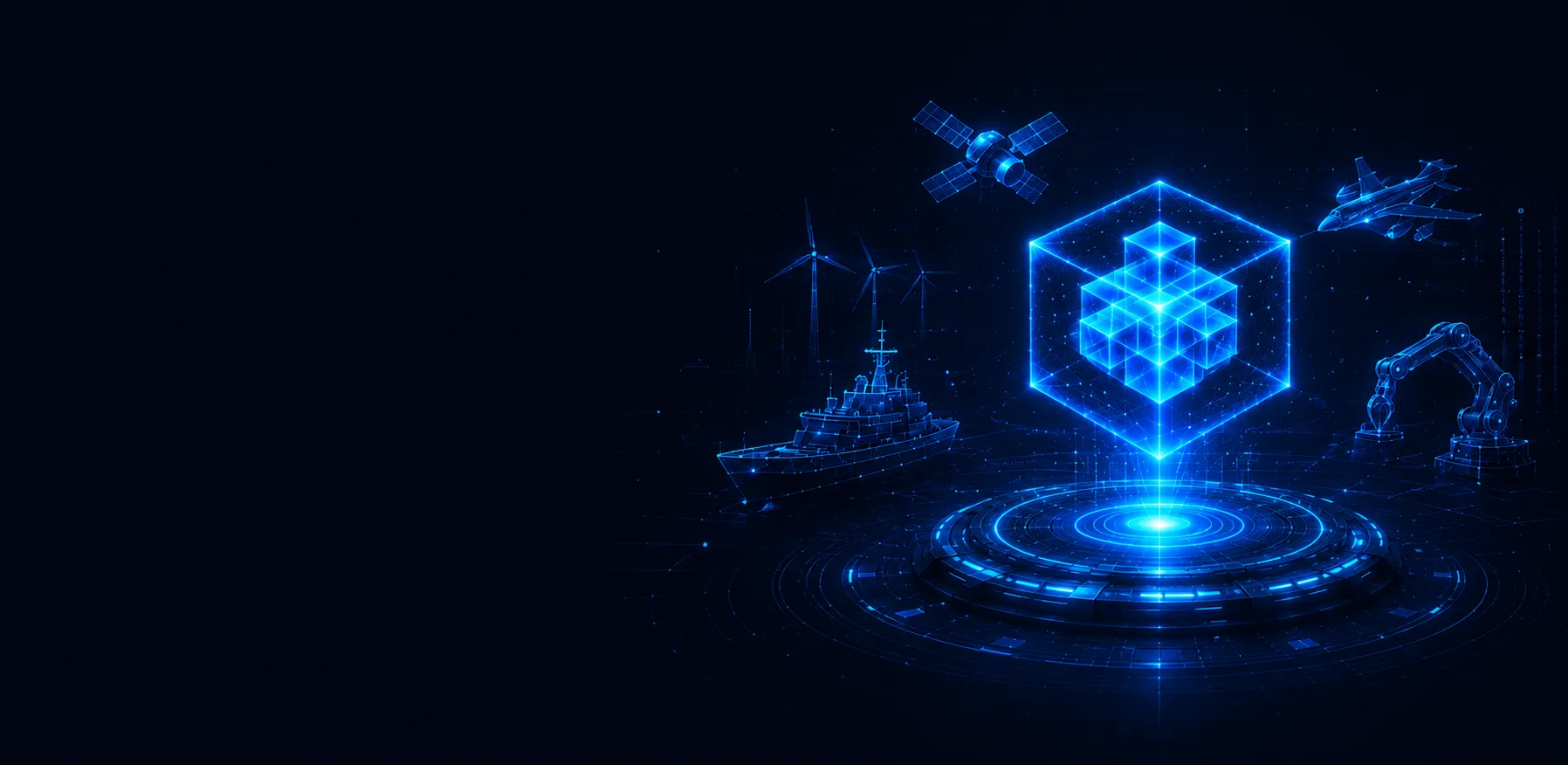
Industry 5.0 demands speed, precision, and adaptability—without compromising traceability.
Neodustria turns product development into a continuous, intelligence-driven pipeline by connecting PLM, design, simulation,
planning, and manufacturing execution in one environment.
Transforming an idea into a real, effective product should not require weeks of manual coordination, disjointed tools, and trial-and-error iteration. In heavy industries, slow iteration translates directly into lost revenue, late programs, and quality risk.
That is why Product Lifecycle Management (PLM) is foundational: it maintains a single source of truth across requirements, CAD, simulation evidence, manufacturing plans, and change control—so decisions remain synchronized from concept to shop floor.
Overview: Idea to Production as a Single Pipeline
With a high-level idea-to-production approach, manufacturers replace slow iteration and manual coordination with precision automation, physics-guided engineering intelligence, and real-time feedback loops. Neodustria runs engineering workflows as a continuous pipeline: design, simulation, planning, and manufacturing remain connected and measurable at every step.
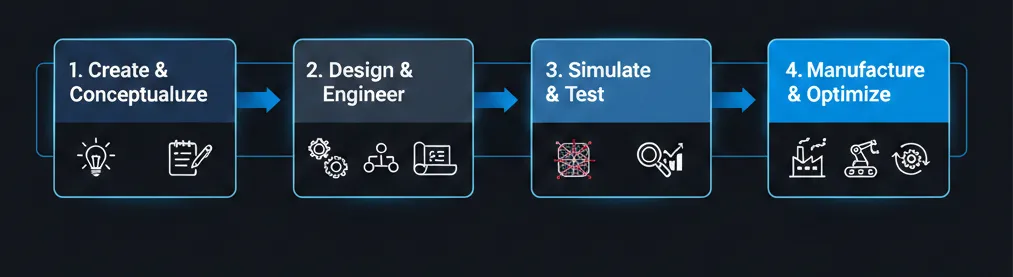
Diagram: A unified workflow connecting PLM, 3D design, physics-aware simulation, and manufacturing optimization.
| Traditional Workflow | Neodustria Workflow |
|---|---|
| 🐢 Slow iteration cycles | 🚀 45%+ faster design lifecycles |
| 💸 High operational costs | 💰 Up to 50% cost reduction through automation and reuse |
| ⚠️ Limited feedback | ✅ Real-time feedback across design, simulation, and production |
| 🛠 Manual coordination | 🔗 Integrated PLM + automated workflow orchestration |
The Role of PLM in Industry 5.0
In Industry 5.0, digital transformation is not “automation at any cost”—it is human-machine collaboration at scale. PLM enables that collaboration by ensuring the same product intent and evidence are shared by engineers, designers, quality teams, and manufacturing.
Neodustria’s PLM foundation enhances collaboration, quality control, compliance, and long-term product intelligence by keeping requirements, models, and decisions synchronized—while making every change auditable.
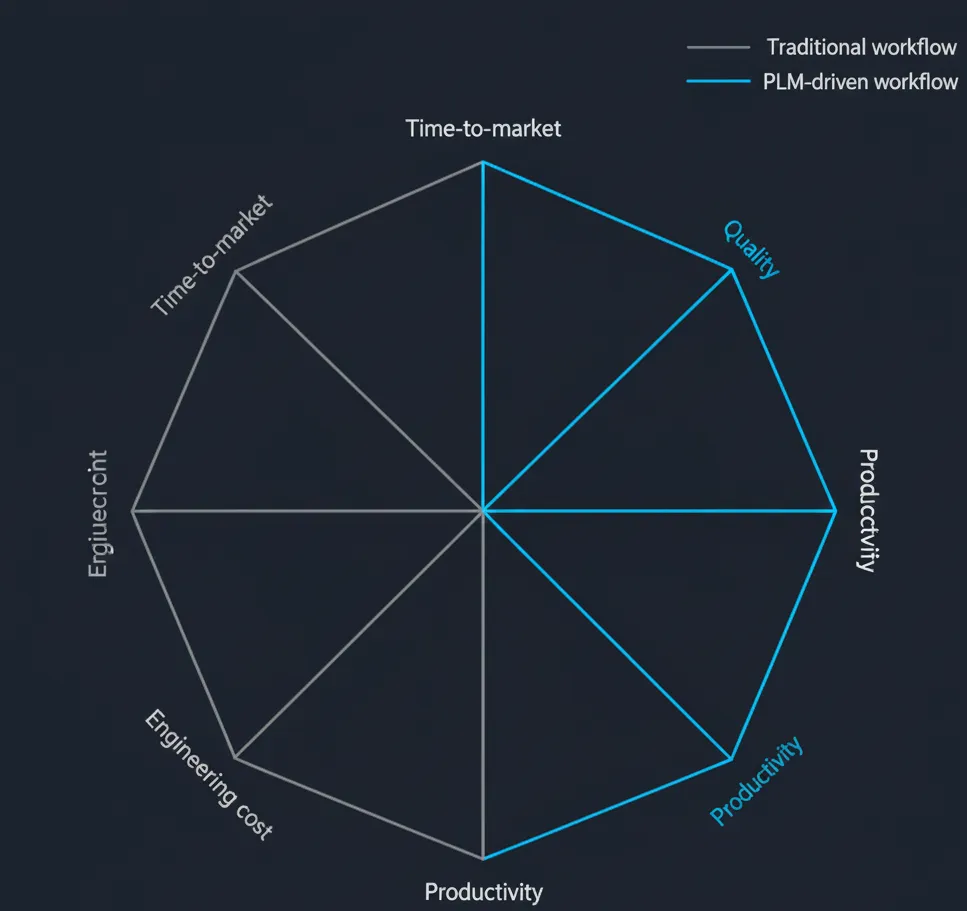
Chart: Typical improvement ranges when PLM is integrated with simulation and execution.
Breakdown of the 4-Step Framework
A structured, iterative approach reduces risk and accelerates delivery. Neodustria follows a four-step workflow to move an idea into scalable production with proper engineering and validation. This model blends PLM, automated simulation, and intelligent tooling, treating design and manufacturing as a single, data-rich lifecycle.
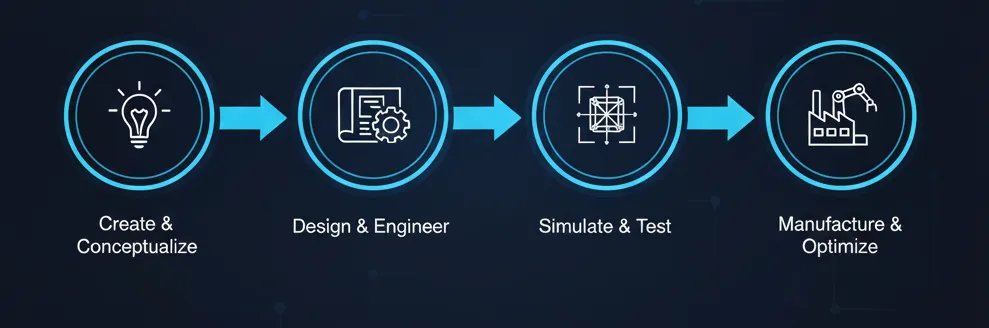
Diagram: Create & Conceptualize → Design & Engineer → Simulate & Test → Manufacture & Optimize.
Step 1 — Create & Conceptualize
Convert raw ideas into validated digital concepts. Neodustria uses intelligence-enhanced 3D modeling and physics-aware pre-checks to surface issues early and reduce late-stage redesign.
- Reduces unnecessary prototyping and material waste
- Improves early decision-making through rapid feasibility checks
- Validates whether designs meet target requirements and standards
- Transforms ideas into traceable digital models governed by PLM
Step 2 — Design & Engineer
Refine concepts into production-ready models. Neodustria provides cloud collaboration, version control, and intelligence-assisted optimization so teams can work in parallel without losing coherence.
- Cross-functional collaboration between engineering and design
- End-to-end version control and traceable change management
- Reuses validated components, templates, and simulation evidence across programs
- Reference benchmark: cutting production delays by ~30% when digital continuity is enforced
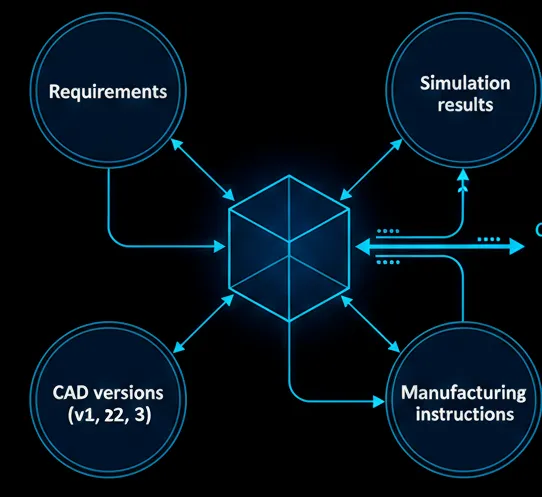
Diagram: How a single change propagates through requirements, CAD, simulation evidence, and manufacturing instructions.
Step 3 — Simulate & Test
Validate virtual designs before manufacturing. Neodustria uses multi-scale simulation, stress tests, and digital twins to accelerate iteration, reduce physical testing, and minimize prototyping costs.
- Continuous improvement through real-time feedback loops
- Multi-physics validation: structural, thermal, mechanical, and operational parameters
- Reduced physical tests for faster time-to-market
- Digital Twin Technology supports more accurate predictions and monitoring
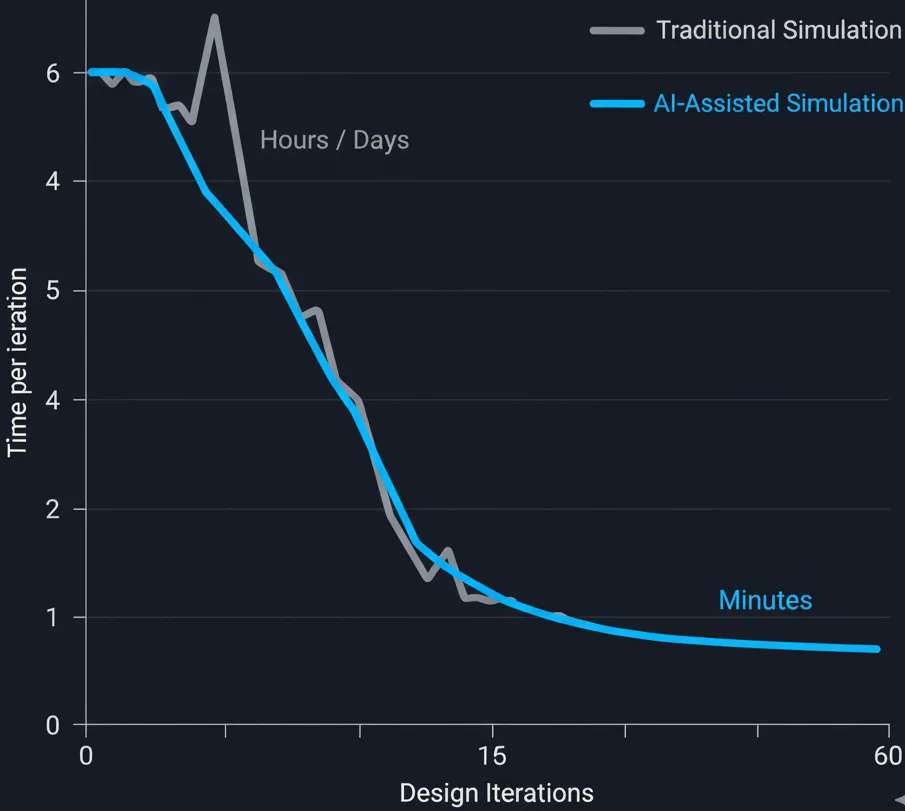
Chart: How automation and physics-aware models compress iteration cycles.
Step 4 — Manufacture & Optimize
Convert validated designs into scalable production. Neodustria integrates PLM, design, and factory systems to monitor performance, optimize production planning, and preserve quality across the lifecycle.
- Alignment with factory automation and optimized production planning
- Reduced iteration cycles and accelerated product launch
- Integrated workflows across engineering, manufacturing, and quality
- Scalable architecture to support multi-site industrial operations
“The best factories do not just execute plans—they learn from every cycle.”
When product, process, and performance data stay connected, optimization becomes continuous rather than episodic.
From Concept to Reality: Industrial Excellence Through Neodustria
The journey from idea to production no longer needs to be slow or risky. Neodustria replaces silos by integrating PLM, intelligence-enhanced engineering, simulation automation, and manufacturing optimization into one unified environment—so data informs every decision and production remains consistent with the original intent and real-world constraints.