
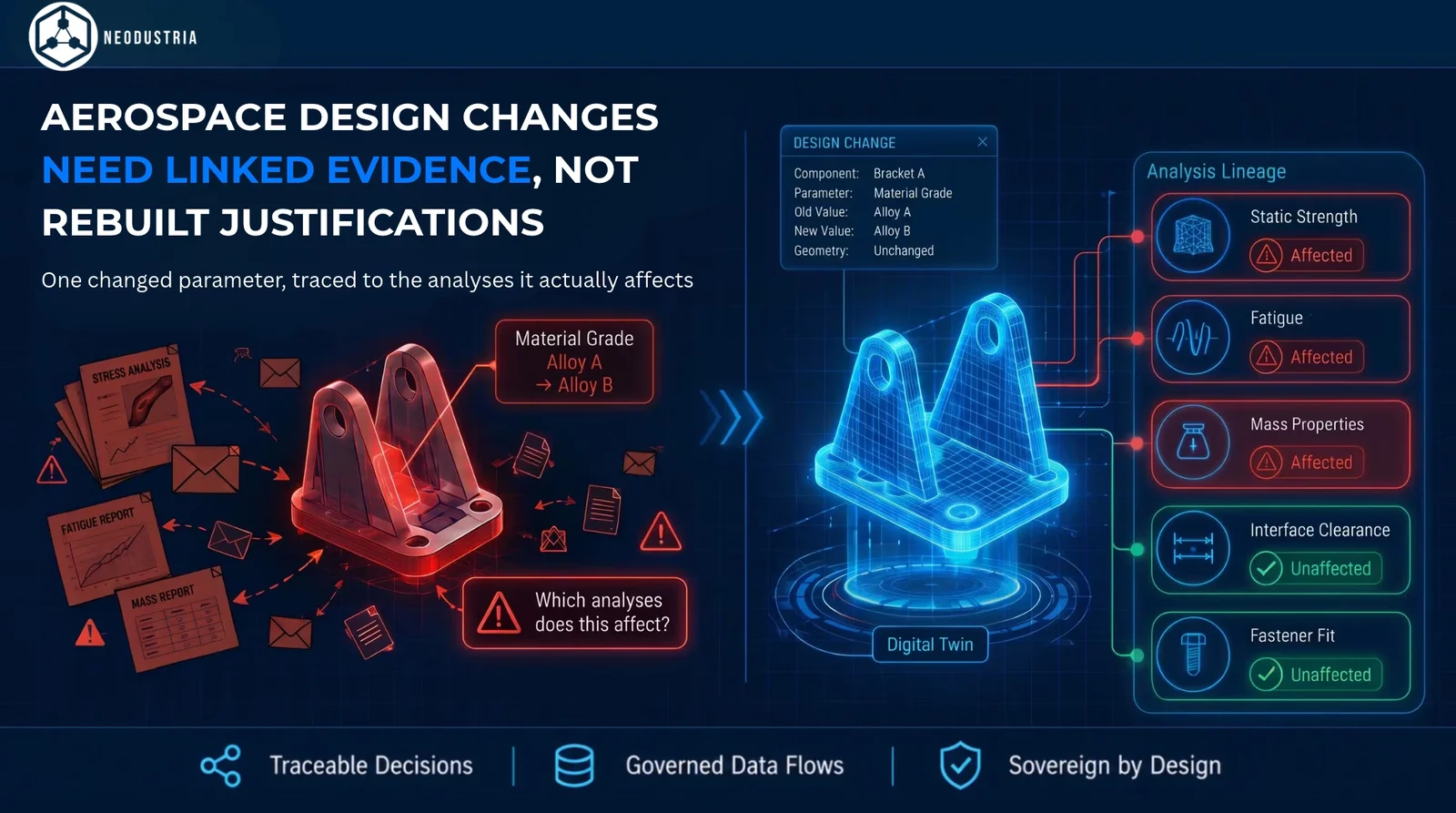
The change is small. The justification is not. Most of the cost sits in finding the evidence, not in producing it.
For VP Aerospace Engineering, Program Directors, and Certification Leads, a component change rarely ends at the drawing. A thicker bracket, a substituted alloy, or a relocated fastener pattern has to be classified, analyzed, and approved before it reaches production. The engineering work behind the original design was done years earlier, by people who may have moved on, in tools that never shared a record.
So the team re-runs analyses that already exist, or reopens questions that were settled for good reasons. In aerospace, every change to an approved design passes through review, so missing evidence turns a small modification into a long one.
What Does Review-Ready Change Evidence Mean?
Review-ready change evidence is the set of analyses, assumptions, and decisions that show why a design is what it is, kept linked to the geometry they justify. When a parameter changes, that record shows which analyses depend on it and which do not.
In European civil aviation, changes to a type design are classified as minor or major under Part 21. A minor change has no appreciable effect on mass, balance, structural strength, reliability, or other airworthiness characteristics; all other changes are major (EASA, Easy Access Rules for Part 21, 21.A.91 and GM 21.A.91). Space hardware follows a parallel logic through qualification and delta-qualification.
Either way, the classification and the approval route depend on one question: what does this change actually affect? Answering it well requires the original evidence, not just the current drawing.
A change is approved on its evidence. Evidence that cannot be found has to be rebuilt.
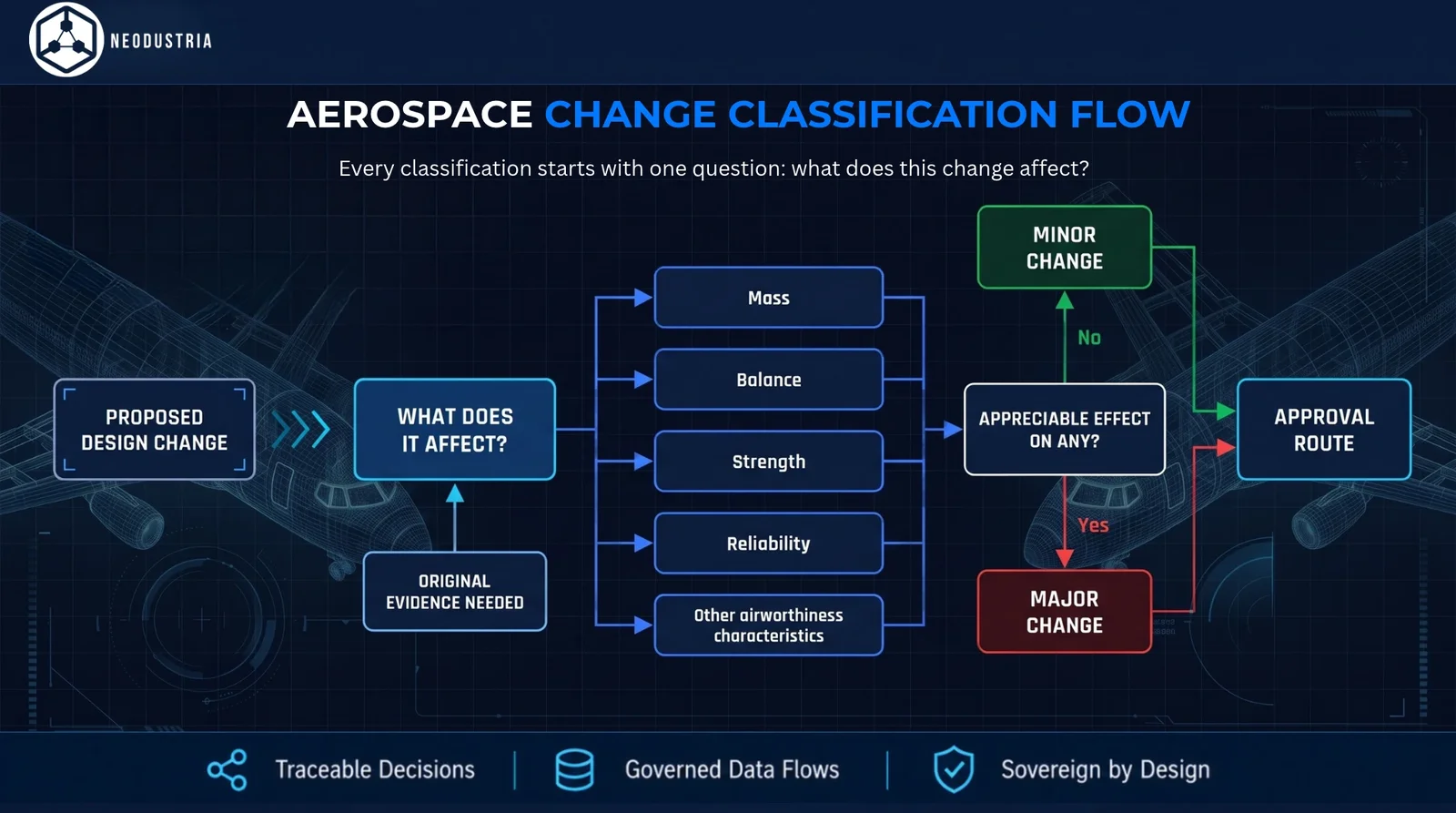
Every classification starts with one question: what does this change affect?
Why Small Aerospace Changes Become Expensive to Justify
In complex products, a change to one part usually forces changes to others. Research at the University of Cambridge, based on rotorcraft design at Westland Helicopters, modeled this as change propagation: the likelihood that a change crosses an interface, and the share of design work that must be redone if it does (Clarkson, Simons & Eckert, Journal of Mechanical Design, 2004). In the same research program, chief designers reported understanding only roughly half of the helicopter in any degree of detail (Eckert, Clarkson & Zanker, Research in Engineering Design, 2004).
If the people closest to the design cannot hold the whole product in their heads, the dependencies have to live somewhere else. In most programs, they live nowhere in particular:
- Analyses are stored as reports, not as dependencies. The stress report states a margin, but not which geometry revision, material allowables, or load case it rests on.
- Rationale lives in meeting notes and email. Why a radius, a thickness, or a fastener spacing was chosen is rarely recorded next to the feature.
- Rejected alternatives disappear. When a reviewer asks why the original option was not used, the comparison has to be redone.
- Change scope is estimated by memory. Without a record of what depends on what, teams either re-run everything to be safe or under-scope and get questioned later.
- Review effort grows with every gap. A small change can be expensive to design and expensive to review, because each missing link adds an analysis to rebuild.
Existing PLM and simulation tools manage files and runs well. They were not designed to keep each decision connected to the evidence that produced it.
Time makes the gap wider. Aerospace products stay in service for decades, and many changes arrive long after the original analysis: a supplier discontinues a material, a production process is updated, or an in-service finding calls for reinforcement. By then, the evidence for a decision made two or three years earlier is hard to trace, even when every report still exists somewhere.
Engineering Change Management by the Numbers
The cost is not limited to aerospace. European research on engineering change management shows how much engineering capacity changes absorb across complex product industries.
| Finding | Figure | Source |
|---|---|---|
| Share of total R&D capacity consumed by engineering change management | Almost 1/3 | Engineering Change Management Report 2011 (90+ engineering firms, Denmark) |
| Share of engineering changes that are critical and endanger project success | About 1/3 | Engineering Change Management Report 2011 |
| Share of all engineering work effort caused by changes | About 30% | Fricke, Gebhard, Negele & Igenbergs, Systems Engineering, 2000 |
| Share of a helicopter that chief designers reported understanding in detail | Roughly 1/2 | Eckert, Clarkson & Zanker, Research in Engineering Design, 2004 |
When a third of engineering capacity goes to changes, the speed of change impact analysis becomes a program-level cost, not a detail.
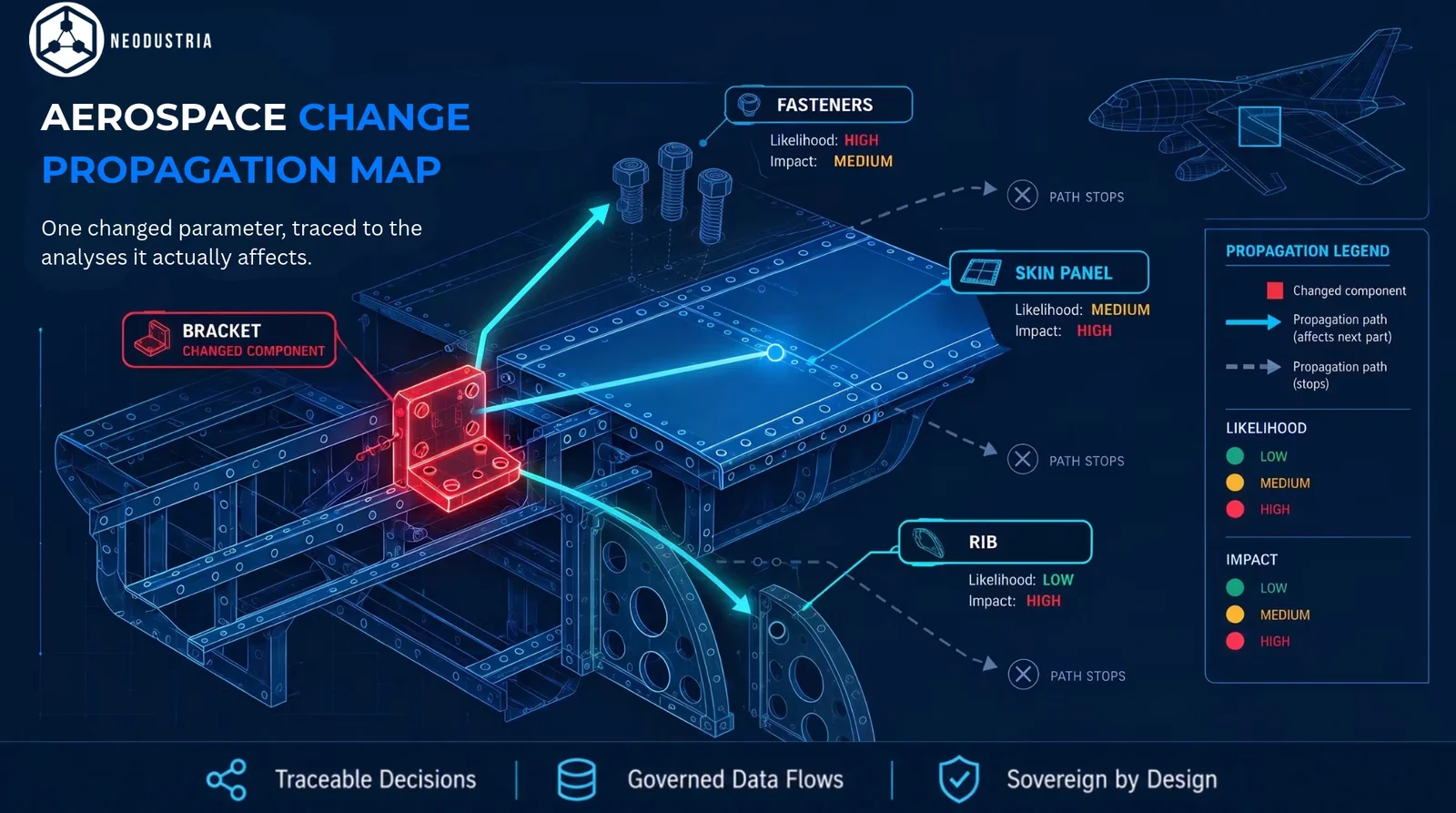
In complex products, a change to one part travels across interfaces to others.
Where Review-Ready Evidence Matters Most
Not every change carries the same evidence burden. The most common triggers in aerospace programs share one feature: they touch decisions made long before the change was proposed.
- Material and supplier substitutions. A new alloy grade, a different supplier, or an obsolete specification forces the team to show that allowables, corrosion behavior, and process limits still hold.
- Manufacturing process changes. A new forming, machining, or joining process can change residual stresses or surface condition, which reopens fatigue questions even when the geometry is unchanged.
- Weight reduction and design optimization. Thinning a web or removing material changes structural margins directly, so the original load cases must be traced and re-evaluated.
- Repairs and in-service findings. Repairs follow their own classification under Part 21, and they depend on the same original evidence: what the part was designed to carry, and why.
- Interface and installation changes. Relocating a fastener pattern or a bracket can affect neighboring parts, which is where change propagation is easiest to miss.
In each case, the engineering task is usually well understood. The time goes into finding and confirming the evidence the change depends on.
The Solution: Decisions That Stay Linked to Their Analyses
Neodustria's Unified Industrial Intelligence Platform treats design rationale as engineering data. Each decision is recorded on the Industrial Digital Thread together with the geometry revision, material data, load cases, and simulation results behind it.
- Version control and branching on the Neodustria Engineering Platform keep every design option, including the ones not chosen, so a reviewer's "why not the alternative?" is answered from the record.
- Complete lineage logs connect each analysis result to the inputs it used, so a changed parameter can be traced to the analyses that depend on it.
- Knowledge graphs and domain ontologies link decisions across design, simulation, and manufacturing in one shared vocabulary, so dependencies are explicit rather than remembered.
- Multi-physics simulation and physics-aware surrogate models are used to re-evaluate the affected load cases, fast enough to compare the changed design against the baseline.
- An audit trail keeps the evidence organized and review-ready, from the original decision to the proposed change.
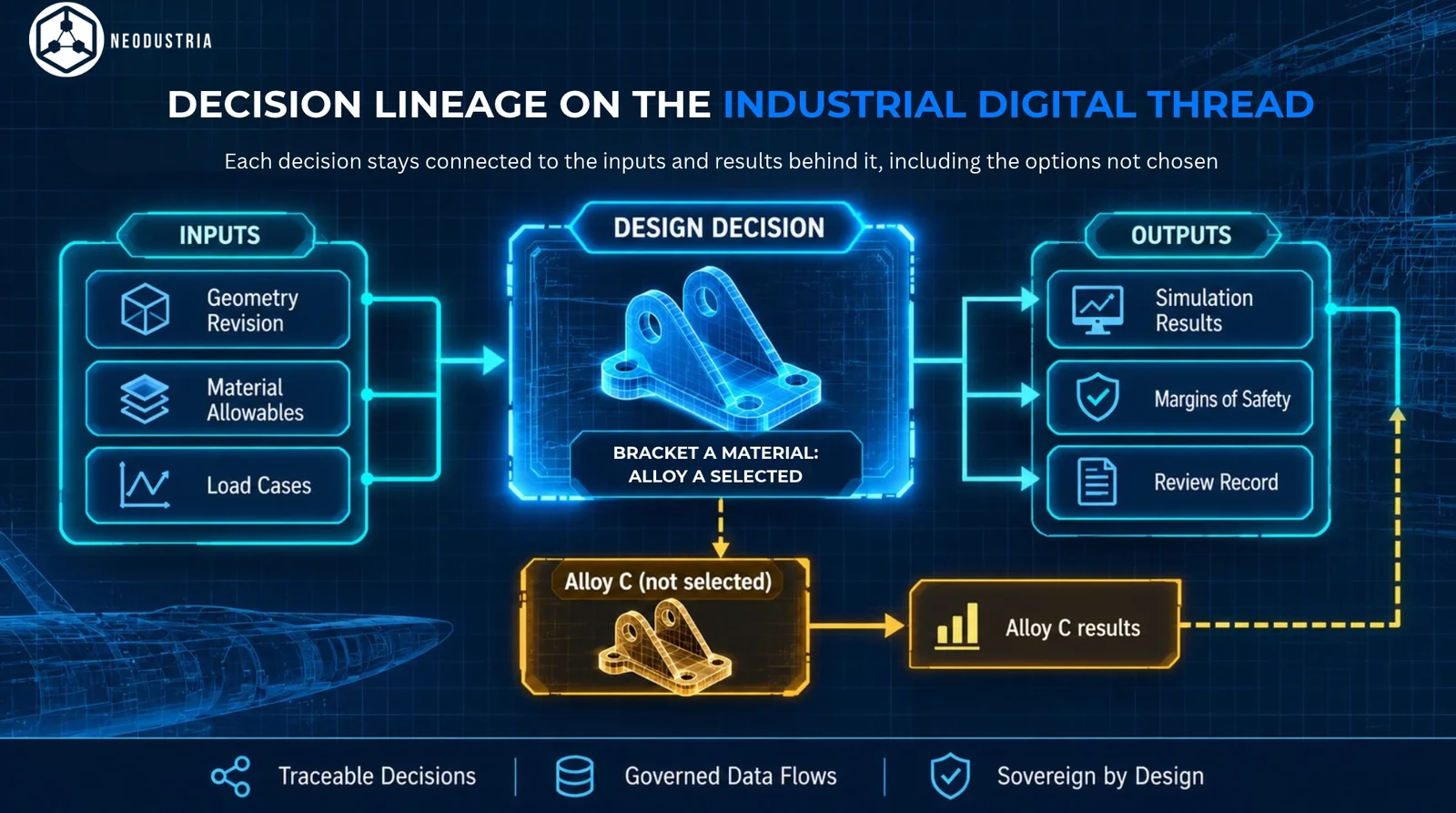
Each decision stays connected to the inputs and results behind it, including the options not chosen.
What Is Recorded With Each Design Decision
A decision record is only useful in review if it answers the questions a reviewer will ask. On the digital thread, each decision carries five linked elements:
| Record element | What it captures | Why it matters in review |
|---|---|---|
| Geometry revision | The exact model version the decision applies to | Confirms the analysis matches the part being changed |
| Material data | Grade, allowables, and process assumptions used | Shows which results depend on the material |
| Load cases | Static, fatigue, and thermal cases evaluated | Defines what was checked and what was not |
| Simulation results | Margins and outputs from each analysis | Provides the baseline a change is compared against |
| Rationale and alternatives | Why this option was chosen over others | Answers "why not the alternative?" from the record |
How a Change Is Traced
When an engineer proposes a change, lineage logs replace memory as the starting point. The engineer traces the changed parameter to every analysis that used it, and sees which analyses rest only on unchanged inputs. Those keep their original evidence attached, so the review can focus on what actually moved.
The affected load cases are then re-evaluated on the same geometry revision. Physics-aware surrogate models give a fast first estimate of how margins move, and full multi-physics simulation confirms the results where the margin is tight. Because the models are constrained by physical laws, each output can be explained in engineering terms, the principle set out in Neodustria's Research Vision for explainable, physics-grounded industrial intelligence.
Built Into Existing Engineering Workflows
Aerospace teams already rely on established CAD, PLM, and simulation tools. Neodustria does not replace that record of files and runs; it connects to it. Native CAD, PLM, and ERP connectors bring geometry and configuration data onto the digital thread, while the decision record adds the link between each choice and its evidence.
Engineering data stays on EU-hosted infrastructure with region-pinned storage, part of the EU data sovereignty and audit trail included in every Neodustria engagement model, so aerospace design evidence remains governed and traceable under the program's control.
The result is scoped change: teams identify what a modification touches before they start re-analysis, and present organized evidence for the parts that need review.
Before: re-run everything, or defend the scope from memory. After: trace the change, re-run what it touches, show the record.
Classification and approval remain with the design organization and the authority. Neodustria does not reduce what regulators require. It helps teams scope the review and bring the evidence to it.
What Changes for Each Role
- VP Aerospace Engineering: fewer analyses rebuilt from scratch, and engineering capacity spent on the change itself rather than on reconstructing its history.
- Program Directors: change scope defined early, so schedule and cost estimates for a modification rest on traced dependencies instead of assumptions.
- Certification Leads: organized, traceable evidence for each change, showing the analyses it affects and the ones it does not, ready to support classification and review.
Example: An Alloy Substitution on a Structural Bracket
A supplier proposes replacing the aluminum alloy on a secondary-structure bracket with an alternative grade, for availability reasons. The bracket was qualified four years earlier. The scenario reflects a common change type in aerospace programs and is described in general terms, without reference to a specific program.
Without linked evidence: the team locates the original stress report, cannot confirm which allowables it used, and re-runs static, fatigue, and fastener analyses to be safe. The rationale for the original grade is reconstructed from an email thread.
With linked evidence, the chain is explicit:
- 1. Proposed change: material grade on bracket, geometry unchanged.
- 2. Lineage trace: the record shows which analyses used the material allowables and density (static strength, fatigue, corrosion, mass) and which used geometry only (interface clearance, fastener fit).
- 3. Targeted re-analysis: affected load cases are re-run on the twin against the same geometry revision.
- 4. Comparison: new margins sit beside the baseline and beside the alternatives considered originally.
- 5. Decision record: the engineering decision, its evidence, and the unaffected analyses are packaged for classification and review.
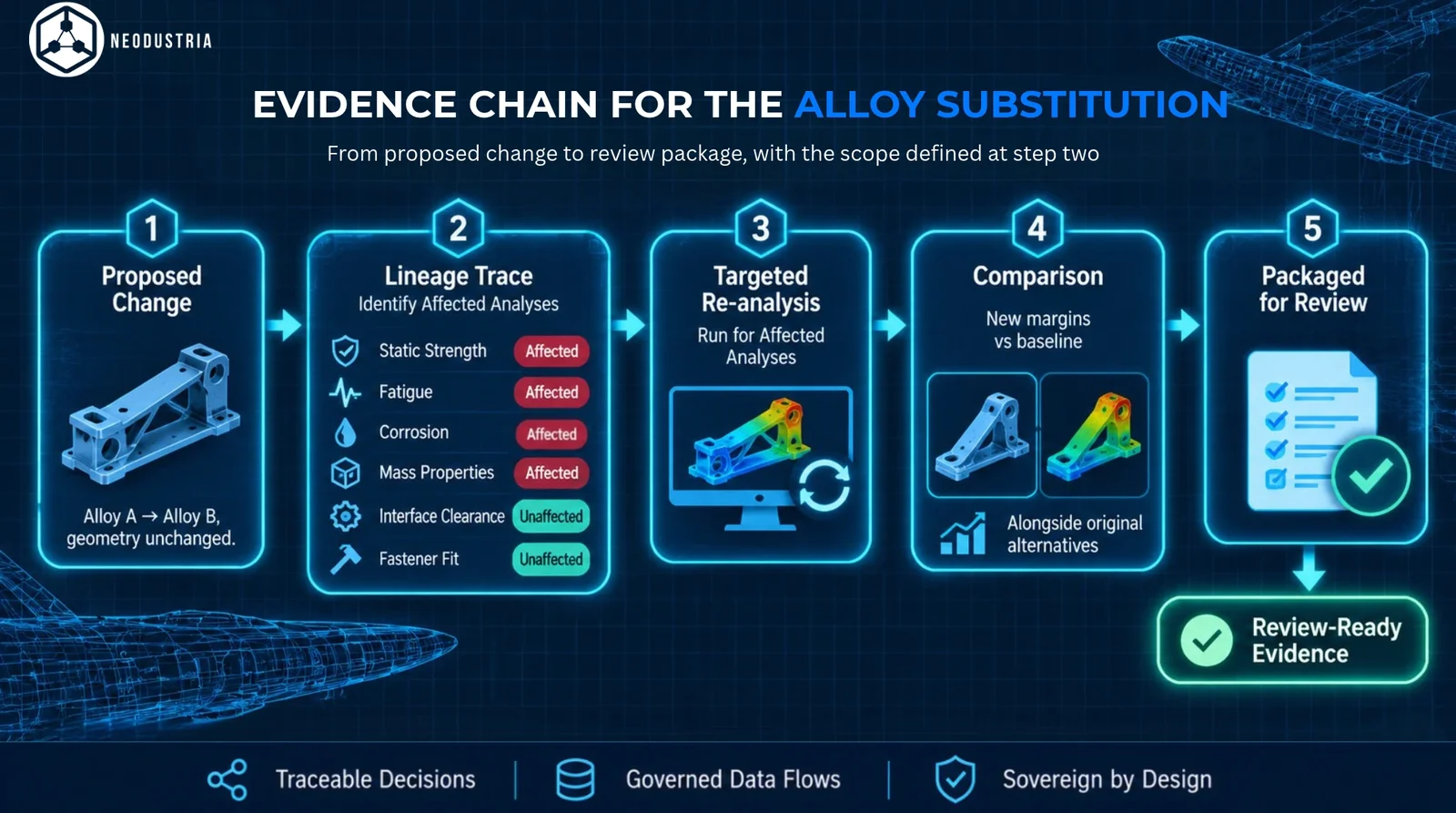
From proposed change to review package, with the scope defined at step two.
Aerospace Design Change Management: Traditional vs Linked-Evidence Workflow
How each workflow handles the same change, stage by stage. The effort involved depends on the program, the component, and the maturity of its engineering data.
| Aspect | Traditional Change Workflow | Neodustria Linked-Evidence Workflow |
|---|---|---|
| Original rationale | Reconstructed from reports, notes, and email | Recorded with the decision on the digital thread |
| Change scope | Estimated by memory, or everything re-run | Traced through lineage to the dependent analyses |
| Re-analysis | Broad re-runs to be safe | Affected load cases re-run on the same geometry revision |
| Rejected alternatives | Lost, redone if a reviewer asks | Kept as branches with their results |
| Review package | Assembled at the end | Organized and review-ready from the start |
Final Verdict
Aerospace programs cannot avoid design changes, and they should not avoid review. What they can avoid is rebuilding the evidence each time. Linking every decision to the analyses behind it shortens the loop between proposed change, scoped re-analysis, and organized evidence for review. This is the principle behind Neodustria's industrial intelligence for aerospace: engineering decisions that remain explainable and traceable long after they are made.