
Production does not fail suddenly due to one reason - it destabilizes before the alarms trigger.
In industrial operations, plant directors, VP operations, and chief engineers are accountable for uptime, yield, and asset life. But without an integrated, physics-aware intelligence layer, they are forced to make subjective inference when approving production targets and signing off on operational risk.
Legacy silos fragment operational truth. Maintenance gets scheduled without a real view of stress, load, fatigue, and degradation across assets — because systems record events, but do not explain physical behavior.
Over 70% of industrial plants report that disconnected MES, CMMS, and PLC systems contribute to production volatility,
asset failures, or production errors at least once per month.
(Source: Plant Engineering Research)
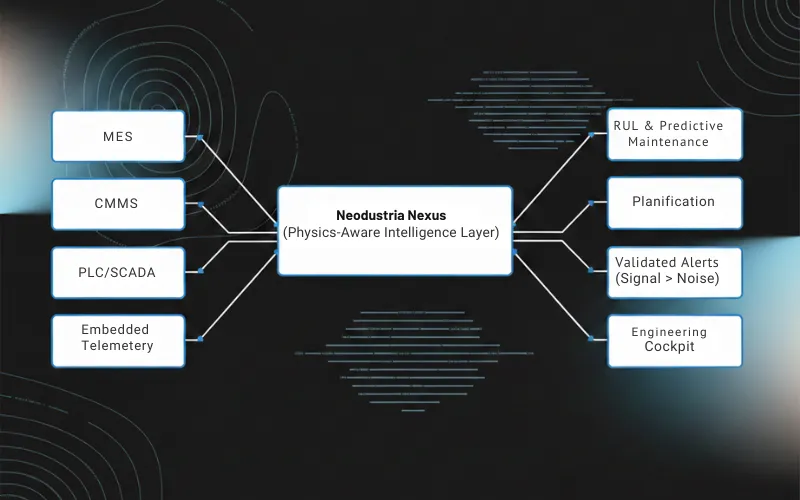
Neodustria addresses this structural gap through the Neodustria Nexus — a single physics-aware intelligence layer unifying MES, CMMS, PLC, and embedded systems into a Sovereign Industrial Cloud. It improves engineering operations by explaining what happened — and why.
In this article:
- Why Legacy Systems Alone Don’t Deliver Engineering Clarity
- Unified Engineering Intelligence
- MES Integration: From Production Data to Engineering Insight
- CMMS Systems for RUL-Based Validation
- Embedded Software Meets Digital Twin Technology
- Quantified Impact: Before vs After Integration
- Engineering Clarity Is the Real Industrial Advantage
Why Legacy Systems Alone Don’t Deliver Engineering Clarity
Legacy systems can perfectly record events, but they do not explain behavior. A temperature spike or vibration alarm may be logged — but the “why” remains invisible without physics context.
Systems operating in isolation cannot connect stress, load, fatigue, wear, and throughput decisions into one coherent engineering narrative. Engineering clarity requires evaluating physical constraints and operational signals together inside a physics-aware intelligence layer.
Unified Engineering Intelligence
Disconnected systems create blind spots. Leadership signs off risk without understanding how stress, wear, and load accumulate in real time. Neodustria connects legacy systems into one unified engineering environment: MES + CMMS + embedded telemetry + Physics-Aware Validation.
Production efficiency improves by 10–25% in plants that integrate MES, CMMS, and digital twin telemetry into a single engineering intelligence layer.
(Source: iFactory Research)
The outcome is measurable: fragmented data becomes actionable engineering insight. Operational complexity transforms into industrial advantage — enabling decision-makers to act with confidence and precision.
MES Integration: From Production Data to Engineering Insight
Manufacturing Execution Systems (MES) are the operational hub of modern factories — they tell what was produced and when deviations occurred. But they cannot reliably explain why it happened, because MES focuses on execution logic rather than physical behavior.
Neodustria extends MES beyond execution tracking into engineering intelligence by integrating MES data into a physics-aware digital twin. This transforms MES from a system of record into a system of foresight.
With Neodustria, production cells can:
- Evaluate production plans against asset fatigue limits
- Detect early degradation trends hidden within “normal” output
- Forecast the impact of throughput changes before execution
CMMS Systems for RUL-Based Validation
Traditional CMMS does not evaluate fatigue accumulation, thermal stress, vibration severity, or load variation — which limits its value for engineering-grade maintenance decisions.
Neodustria upgrades CMMS into predictive engineering intelligence by combining maintenance history with high-fidelity telemetry from PLC and SCADA systems. Maintenance decisions become measurable engineering reality — reducing downtime, extending asset life, and stabilizing production across the plant.
Embedded Software Meets Digital Twin Technology
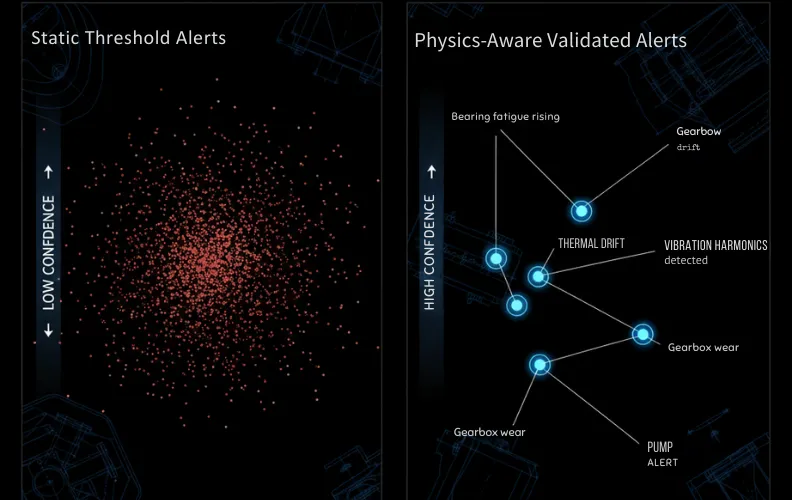
Neodustria connects embedded telemetry directly to high-fidelity digital twins, creating a single intelligence layer linking code, design, and real-world performance.
Intelligence architects can:
- Validate real-time behavior against physics-based performance envelopes
- Detect early-stage anomalies before threshold alarms or safety trips
- Trace operational drift to control logic, parameter tuning, or design assumptions
- Test firmware changes safely inside the digital twin before deployment
- Shift from reactive control to predictive response
Quantified Impact: Before vs After Integration
| Traditional Industrial Workflow | Neodustria (Unified Engineering Intelligence) |
|---|---|
| Disconnected MES and CMMS systems | 100% visibility across MES, CMMS, PLC, and embedded software |
| Reactive maintenance after failure | 25–50% reduction in production volatility via RUL-based predictive validation |
| Production data without engineering context | 30–40% faster engineering decisions through physics-aware intelligence |
| 500+ alerts per shift from static thresholds | 35–45% alert reduction — only validated asset risks |
| High maintenance waste and early asset failure | 20–40% maintenance cost reduction |
| Decisions based on partial truth | Engineering certainty grounded in physical reality |
Engineering Clarity Is the Real Industrial Advantage
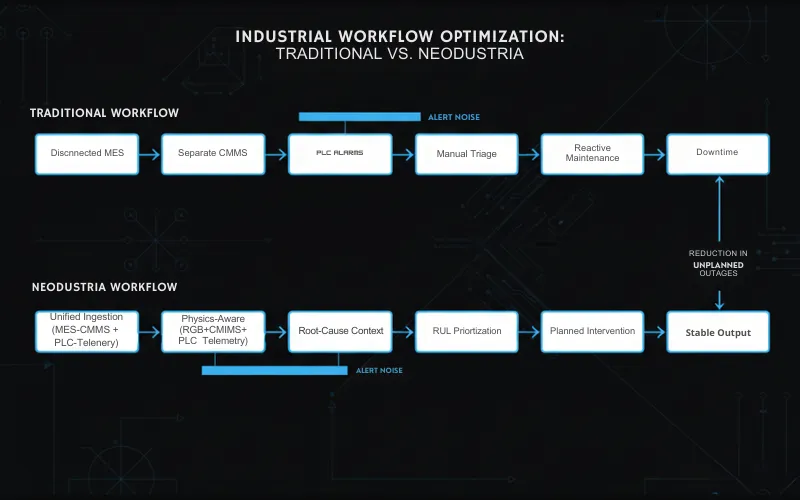
Legacy systems are not broken — they are incomplete. When systems operate in isolation, they create blind spots that destabilize production. Neodustria resolves this by unifying MES production data, CMMS maintenance history, embedded telemetry, and digital twin technology into one engineering-grade intelligence layer.
The result is operational control: maintenance shifts from reactive scheduling to predictive intervention, and industrial data stops being a liability — becoming a measurable advantage.