



Every major engineering achievement begins with decisions that are often invisible to the public. Before a bridge carries its first load, an aircraft leaves the ground, or a turbine completes its first rotation, engineers must answer a fundamental question: which materials should we use? A stronger alloy? A lighter composite? A more heat-resistant polymer? Each choice opens further questions. How will the material behave under repeated loading or changing temperatures? Can it be manufactured into the shape we need? Is it available at the right cost?
Suitability Is Conditional, Not Absolute
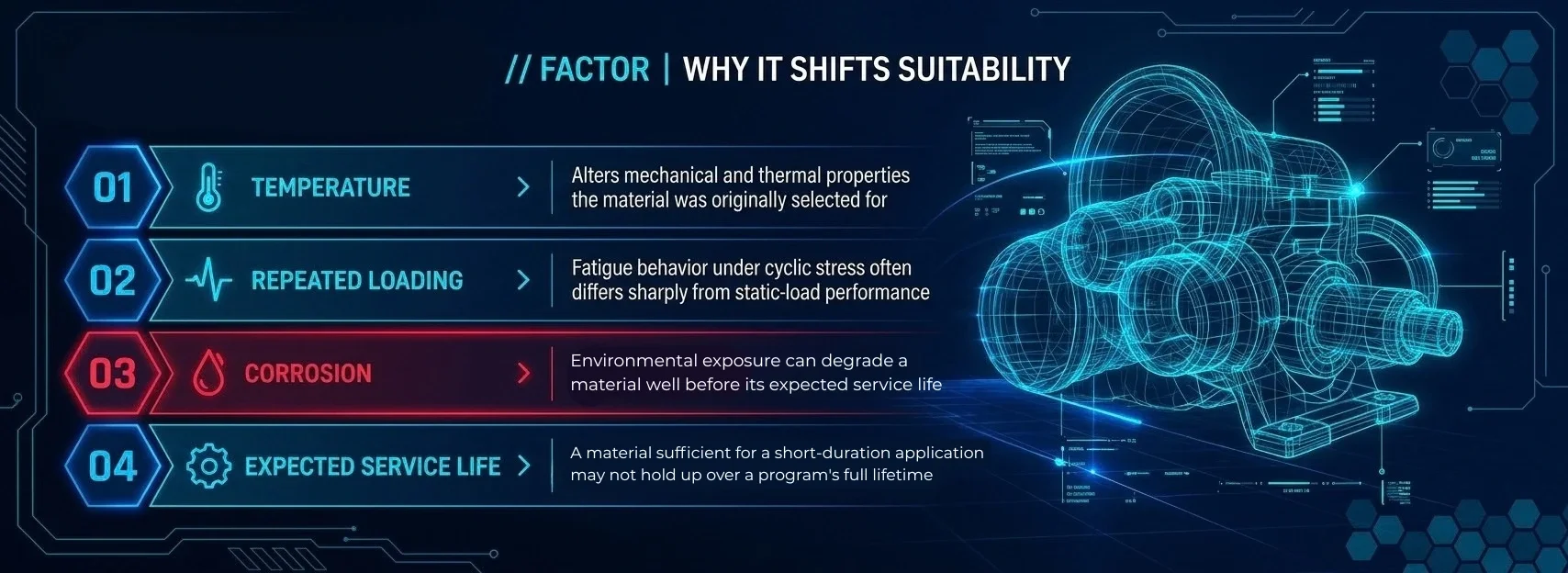
A material's performance depends on its composition, processing history, and internal structure, as well as the conditions in which it's used. A material that performs exceptionally well in one application may introduce real engineering uncertainty in another: temperature, repeated loading, corrosion, and expected service life all shift its suitability. Late discovery of an unsuitable material is costly - the decision can ripple through design, simulation, manufacturing, and project schedule.
Beyond "Which Material Has the Best Properties"
Technical performance is only part of the decision. Even a material that meets the required mechanical and thermal properties may be too expensive, difficult to manufacture, vulnerable to supply disruption, or restricted by regulation. The question extends beyond "which material has the best properties?" It becomes: which material will perform reliably in this application, meet practical constraints, and be supported by sufficient evidence?
Where the Evidence Actually Lives
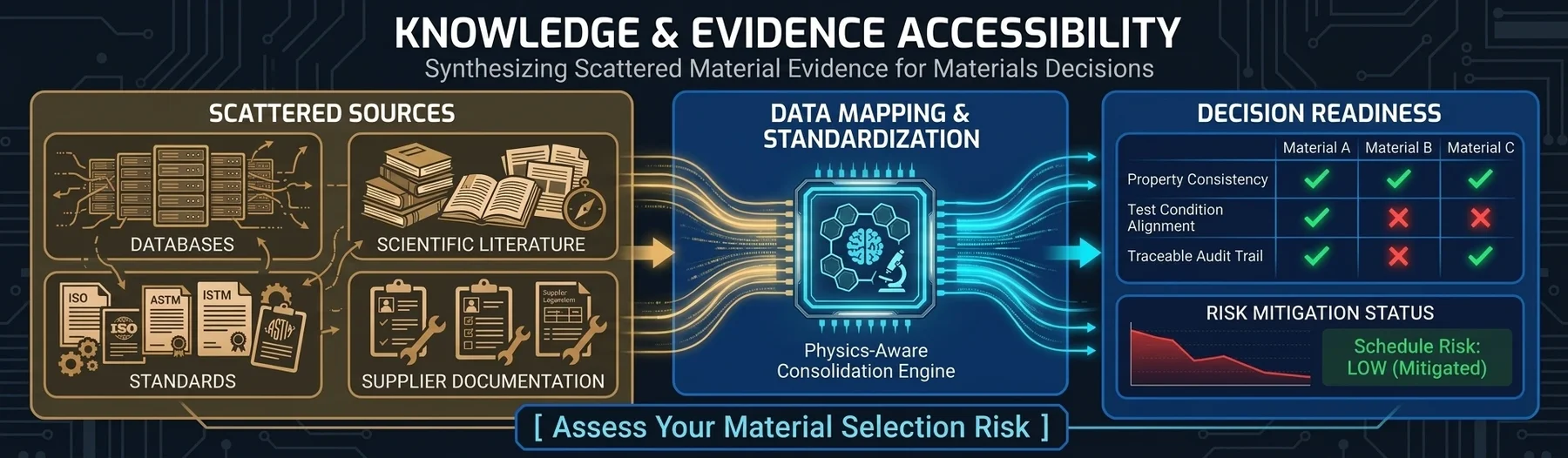
Engineers already navigate these trade-offs; the challenge is bringing together the knowledge needed to evaluate them and knowing when the evidence is sufficient to support a decision. That knowledge is scattered across databases, scientific literature, standards, and supplier documentation. Values reference different processing routes or test conditions, which makes comparisons difficult and leaves gaps that demand further investigation - investigation that shows up downstream as schedule risk, not as a footnote.
Our Mission: Materials Intelligence at Neodustria
At the Materials Intelligence Lab, we're working to connect that scattered knowledge with the engineering decisions it needs to support. Our aim is to help engineers assess materials with a clear understanding of where the data comes from, the conditions under which it applies, and what remains uncertain - so uncertainty is quantified, not hidden. Connecting that evidence with manufacturing, cost, and regulatory constraints makes promising candidates easier to evaluate on their actual merits, not just their datasheet properties.
Connecting Materials, Geometry, and Physics
Within the wider Neodustria platform, we're building physics-aware connections between materials, geometry, and simulation to evaluate how a material is expected to perform in a particular design. At Neodustria, we treat this as one discipline working across three domains of our Industrial Intelligence hierarchy: Materials Intelligence (composition, properties, processing, evidence), Geometry Intelligence (how a design's shape constrains material choice), and Physics Intelligence (how a material actually behaves under load, heat, and time). None of the three is sufficient on its own.
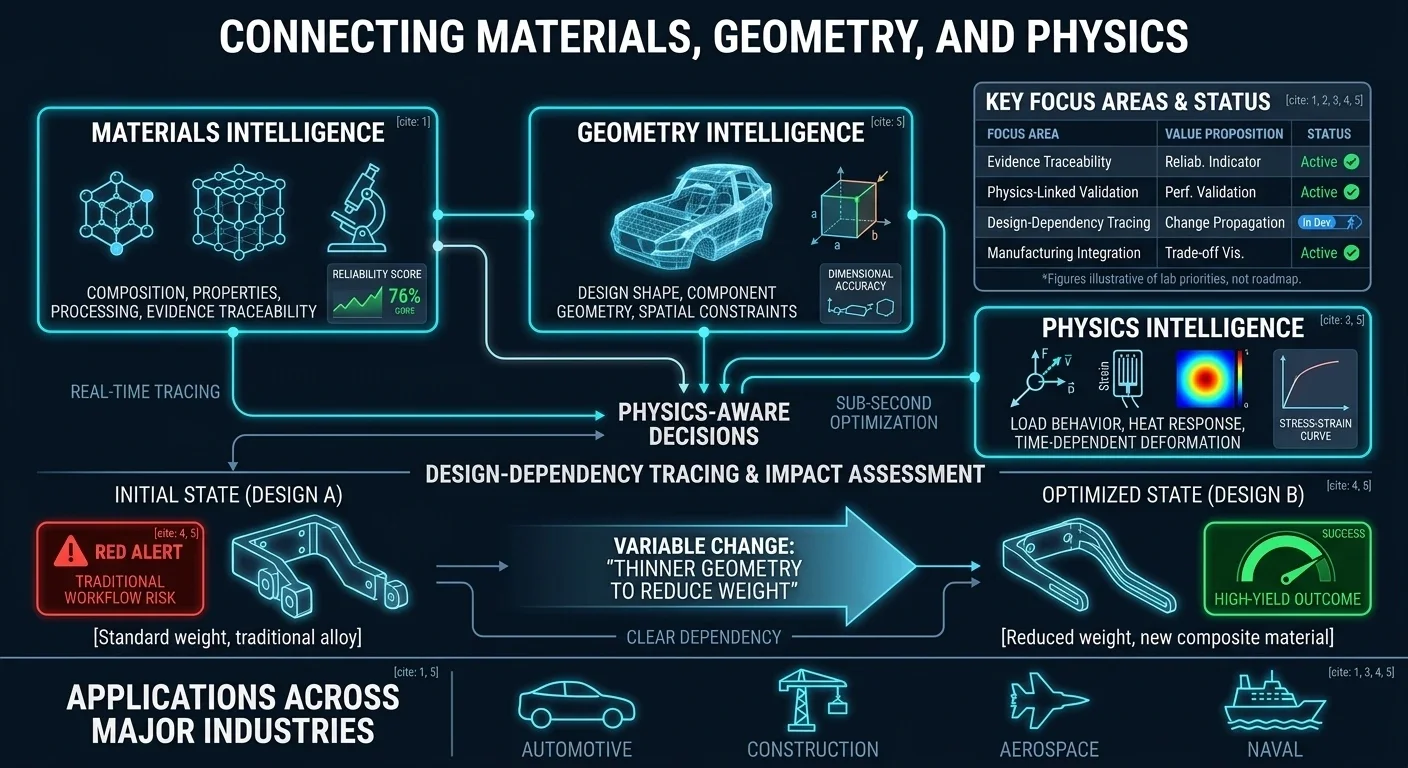
Consider a component made thinner to reduce weight. That change affects its deformation under load, the suitability of the selected material, and the manufacturing options available. Substituting another material then changes the simulation inputs and every conclusion drawn from them. By tracing these dependencies - much as a digital twin traces a physical asset - we help engineers identify what needs reassessment as a design evolves, while preserving the work that's still valid.
This discipline isn't specific to one industry. An Automotive engineer evaluating a lighter composite draws on the same traceable evidence and physics-aware validation as a Construction engineer specifying a structural alloy, an Aerospace engineer selecting a heat-resistant polymer, or a Naval engineer assessing corrosion resistance for a hull component. The domain changes; the discipline behind the decision doesn't.
Architecting Materials Intelligence
Materials decisions go beyond properties in a database. They depend on engineering requirements, material behavior, reliable evidence and real industrial constraints.
At Neodustria, Materials Intelligence connects these elements across the engineering workflow, linking materials with physics and simulation, traceable evidence, design changes, manufacturing, cost, supply and regulation.
Our goal is to turn fragmented material data into qualified, context-aware knowledge for better engineering decisions.
Operationalizing Materials Intelligence
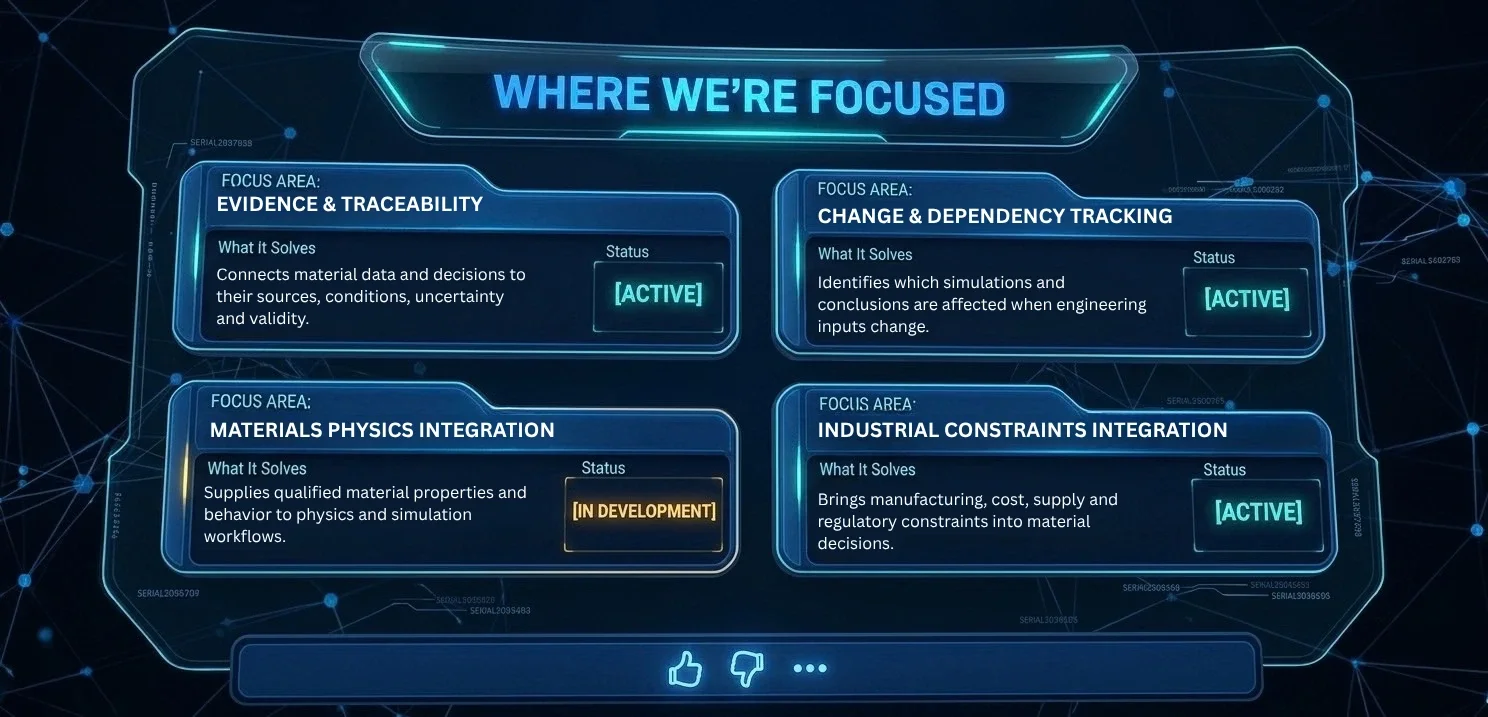
Status reflects our current focus as described in this piece; figures are illustrative of current lab priorities, not a formal product roadmap commitment.
From Materials Intelligence to Engineering Impact
Materials Intelligence should ultimately improve how quickly, confidently and transparently material decisions can be made and maintained throughout an engineering project. We will measure progress through outcomes that reflect both engineering impact and decision quality.
| Metric | What It Measures | Target Direction |
|---|---|---|
| Material evaluation cycle time | Time from "which material?" to a defensible, evidence-backed answer | Materially reduced |
| Late-stage material substitutions | Frequency of material changes discovered after design is already locked | Materially reduced |
| Evidence traceability coverage | Share of material properties used in a design with a documented source and confidence level | Increased toward full coverage |
| Cross-domain reuse | Share of materials evidence validated once and reused across Automotive, Aerospace, Construction, Naval, and Railway programs without re-verification | Increased |
| Uncertainty quantification | Share of material properties carrying an explicit confidence bound, rather than a single unqualified value | Increased |
These are directional targets, not published benchmark results - illustrative of what success means for this work, pending real deployment data.
Beyond accelerating individual tasks, these targets reflect a fundamental shift in the engineering baseline. For Neodustria, success is not defined by adopting new software, but by eliminating the operational friction that occurs when materials data is disconnected from physics and geometry.
By shifting material validation and traceability to the left of the design cycle, our platform is engineered to ensure that every assumption, from structural integrity to cost constraints, is anchored in defensible, confidence-scored data before a single component goes into production. This is how we transform material selection from a bottleneck into a strategic engineering advantage.
Dr. Doha Abdelrahman leads the Materials Intelligence Lab at Neodustria. PhD in Physics, Adolphe Merkle Institute, University of Fribourg.