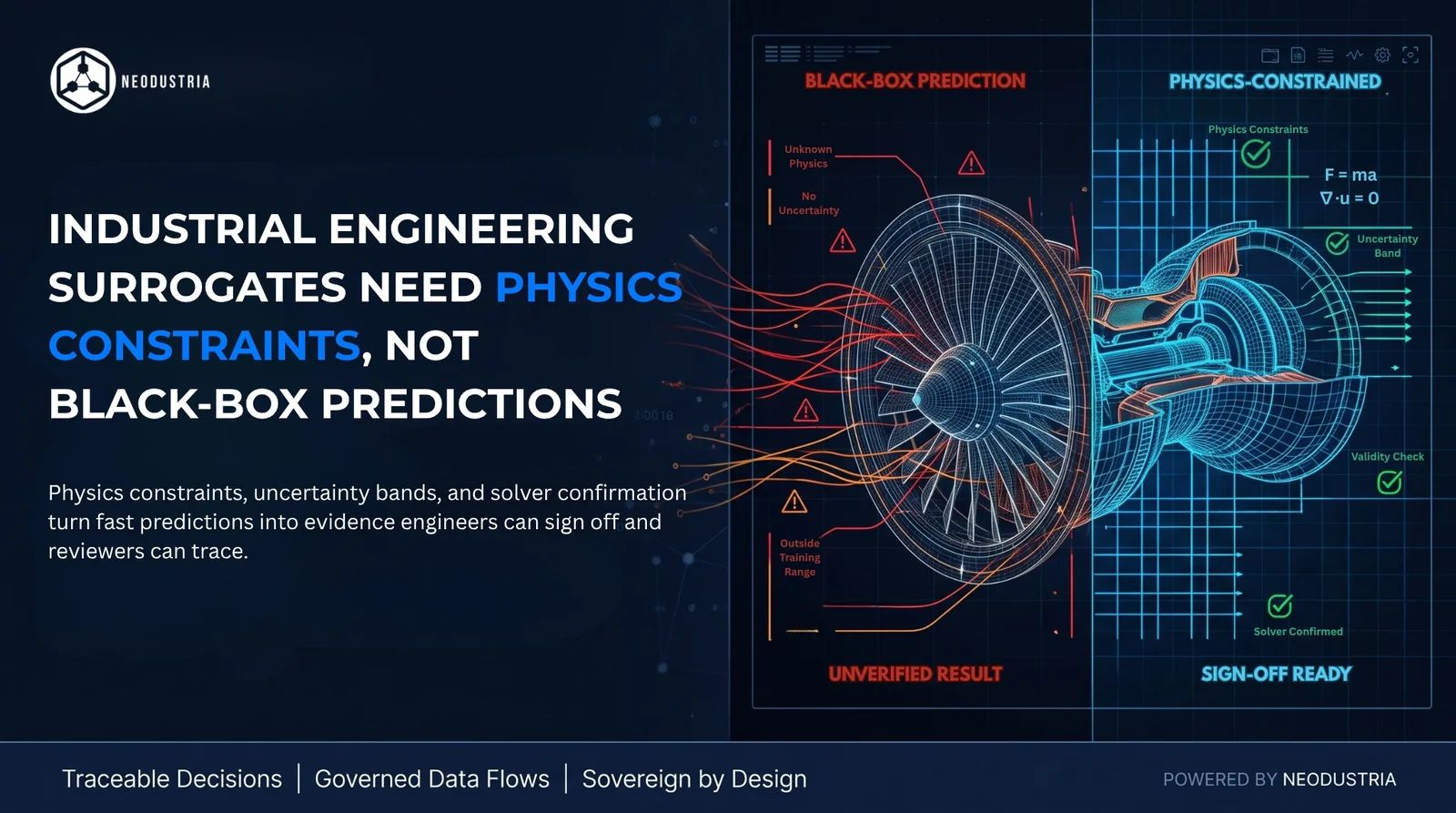
Fast predictions do not shorten design cycles. Trusted predictions do.
For Chief Engineers and Engineering Heads in heavy industry, fast engineering models such as physics-aware engineering surrogates promise more design alternatives in less time. The reality is often different. A model returns a stress value or a temperature in seconds, but no one can say which physical laws it respects, how certain the answer is, or whether the design is even within the range the model was built for. So the result goes back to the full simulation queue, and the time saved disappears.
The bottleneck is not speed. It is credibility.
What Is a Black-Box Engineering Decision?
A black-box engineering decision is a design choice made on a model output that cannot show three things: which physical laws and data produced it, how much uncertainty it carries, and whether the design falls inside the conditions the model was built and tested for.
A model can be accurate on most cases and still be wrong on the one design that matters, with nothing in its output to warn the engineer. Experienced engineers are right to hesitate before signing off on predictions they cannot inspect.
NAFEMS, the international association for engineering simulation, describes the value of verification and validation for simulation credibility as a trade-off between increased confidence in simulation results and the increased risk of using results whose credibility is unknown. Any fast model used in design inherits the same question.
A model that is right on average can still be wrong on the design you build. Engineering needs to know which case it is in.
Why Unconstrained Predictions Stall Design Sign-Off
Classical finite element and computational fluid dynamics solvers remain the reference for design validation, but they were not designed to explore hundreds of alternatives in one review. Fast data-driven models fill that gap, but unconstrained models create three problems:
- No physical guarantee. A model trained only on data can return a result that violates equilibrium, conservation of energy, or a material limit, and still look plausible.
- No uncertainty. A single number with no confidence band gives the engineer no way to judge how much margin to keep.
- No warning outside the training range. When a new design moves beyond the geometries, loads, or materials the model has seen, an unconstrained model keeps answering with the same apparent confidence.
In regulated industries, there is a further cost. A result that cannot be inspected cannot be presented for review, so even a small design change becomes expensive to design and expensive to approve.
The result is a familiar pattern: fast predictions are used for early exploration, but every decision that matters is re-run in the full solver, because the faster result cannot defend itself.
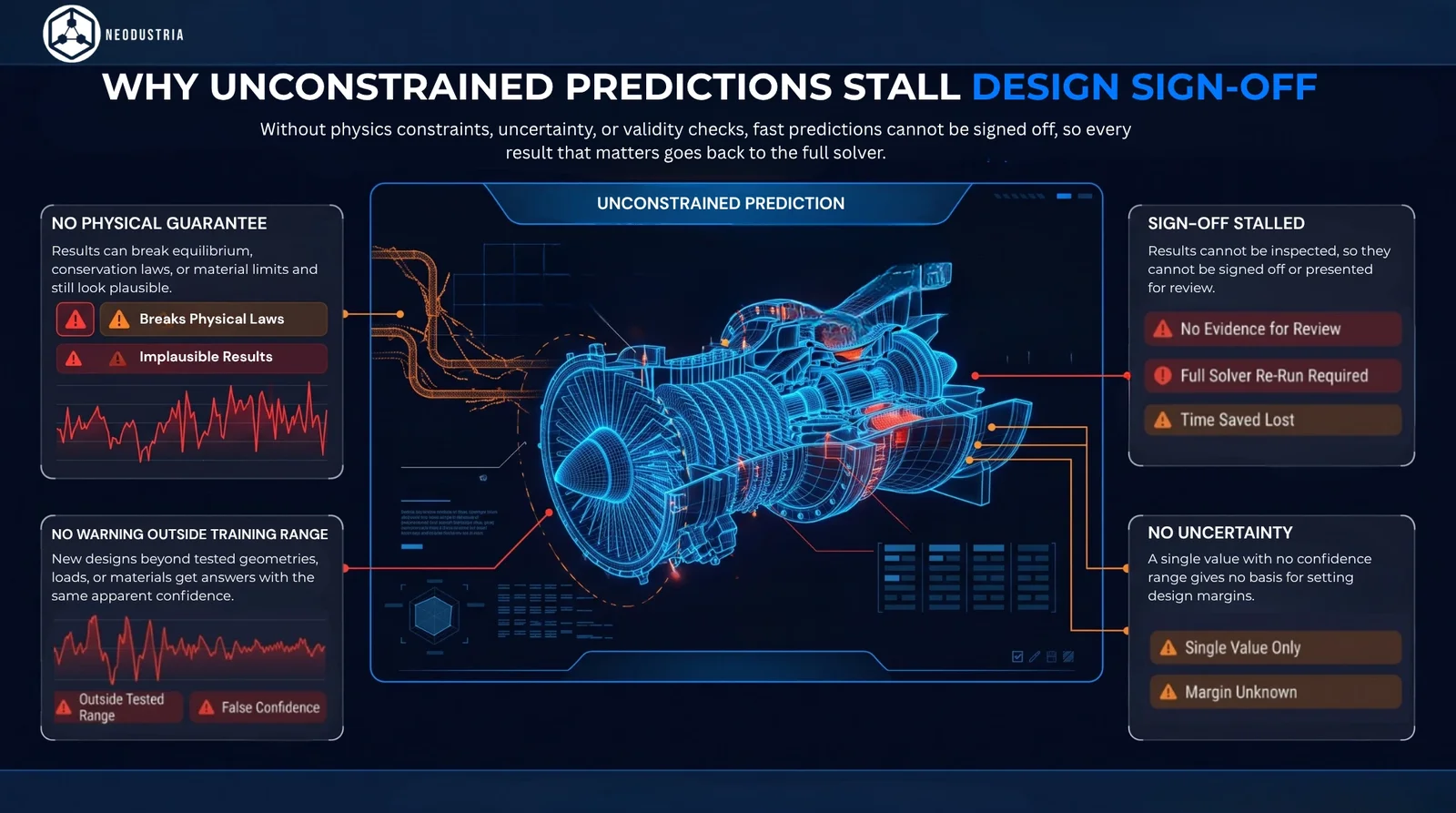
No physical guarantee, no uncertainty, no warning outside the training range: unconstrained predictions stall at sign-off.
The Solution: Physics-Constrained Engineering Surrogates
A physics-aware engineering surrogate is a fast model trained on simulation results that is also required to respect the physical laws of the problem. Rather than learning patterns alone, it estimates the physical consequences of a design, such as stress, deflection, temperature, or flow, while being held to conservation laws, boundary conditions, and material limits.
A widely cited review in Nature Reviews Physics describes how physics-informed learning integrates data with mathematical models, and how enforcing physical laws during training makes these models usable when large datasets are not available, the normal situation in engineering.
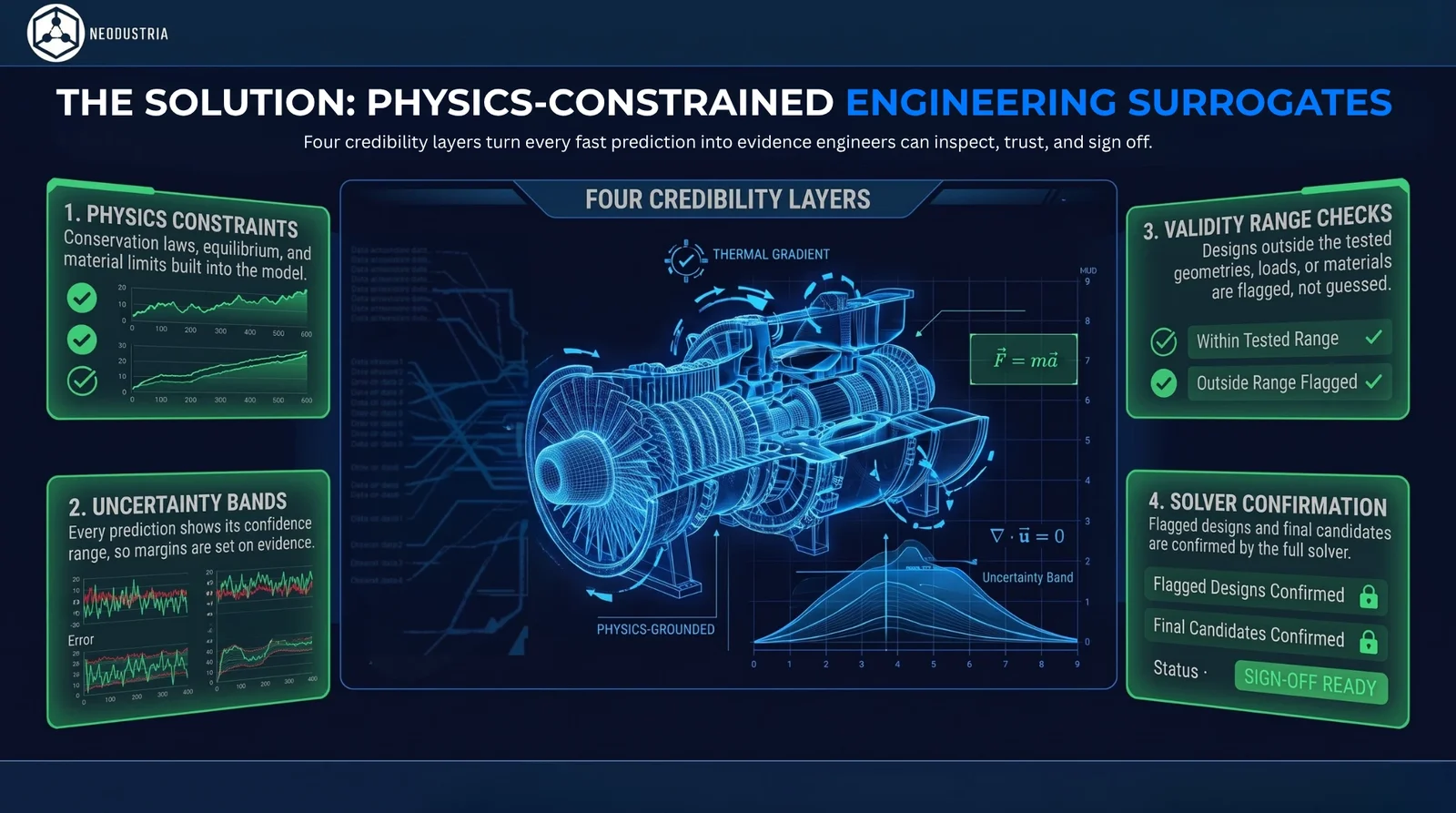
Physics constraints, uncertainty bands, validity range checks, and solver confirmation: four layers that make a prediction sign-off ready.
At Neodustria, every surrogate prediction carries four credibility layers:
- 1. Physics constraints: Conservation laws, equilibrium, boundary conditions, and material limits are built into the model, so a prediction that breaks physics is rejected before it reaches the engineer.
- 2. Uncertainty bands: Every prediction comes with a quantified uncertainty range, so engineers can see how much margin a result needs, not just its central value. Research from ETH Zurich's Chair of Risk, Safety and Uncertainty Quantification shows why this matters: surrogate models approximate a simulator from a limited number of runs, which makes uncertainty quantification affordable where thousands of full simulations would not be.
- 3. Validity range checks: Each surrogate knows the range of geometries, loads, and materials it was trained and tested on. When a design moves outside that range, the prediction is flagged instead of answered with false confidence.
- 4. Solver confirmation: Flagged designs and final candidates are sent to the full solver automatically, so classical simulation is used where it adds the most value: confirming the decisions that matter.
These layers run in the ML Workbench of the Neodustria Engineering Platform, alongside the classical solvers and external simulations they are trained on. They strengthen the Simulate & Test stage of Neodustria's idea-to-production workflow.
In a design review, the surrogate evaluates dozens of variants of a load-bearing component in seconds, rejects those that break material limits, and flags any outside its tested range. Only the flagged variants and the strongest candidates go to the full solver, and the final design is approved with its prediction, uncertainty, validity check, and solver result on record. The same approach applies wherever structural margins drive design decisions, from heavy equipment to aerospace structures.
Design variant → surrogate prediction with uncertainty → physics constraint check → validity range check → solver confirmation → engineer sign-off
Unconstrained models answer every question the same way. Physics-constrained surrogates know when to say "check this."
Review-Ready Evidence for Regulated Design Changes
In regulated industries such as railway, aviation, and aerospace, a design change does not end at engineering sign-off. A new or modified component usually needs regulatory review before it can enter service, and that review carries its own cost.
Two problems make this harder. Safety-critical designs change rarely, so the evidence behind the original decision is often two or three years old and scattered across reports, simulation files, and people who have moved on. And reviewers need to see not only the result, but how it was reached.
Physics-constrained surrogates help on both points. Every prediction is kept with its constraints, uncertainty, validity check, and solver confirmation, linked to the decision it supported. The Neodustria platform maintains this as a traceable record with revision history and impact analysis, so the evidence for today's decision can still be found and presented years later.
Because each decision is linked to the analyses behind it, engineers can also see which analyses a proposed change actually affects. That helps teams scope a change clearly and focus the review package on what has changed, rather than rebuilding all the evidence from the beginning. Regulators still decide what review a change requires; the evidence simply arrives organized, complete, and easy to trace, from aviation airworthiness to railway safety.
A design decision is only as strong as the evidence you can still show for it. Physics-constrained surrogates keep that evidence ready for review.
Black-Box Predictions vs Physics-Constrained Surrogates
| Aspect | Black-Box Prediction | Neodustria Physics-Constrained Surrogate |
|---|---|---|
| Physical consistency | Not guaranteed | Conservation laws, equilibrium, and material limits enforced |
| Uncertainty | Single value, no confidence range | Quantified uncertainty band on every prediction |
| Designs outside training range | Answered with the same apparent confidence | Flagged and sent to the full solver |
| Role of the full solver | Re-runs everything that matters | Confirms flagged and final candidates only |
| Engineer's ability to sign off | Low, result cannot be inspected | High, every result shows its physics, uncertainty, and validity |
| Data required | Large datasets | Simulation results plus physical laws |
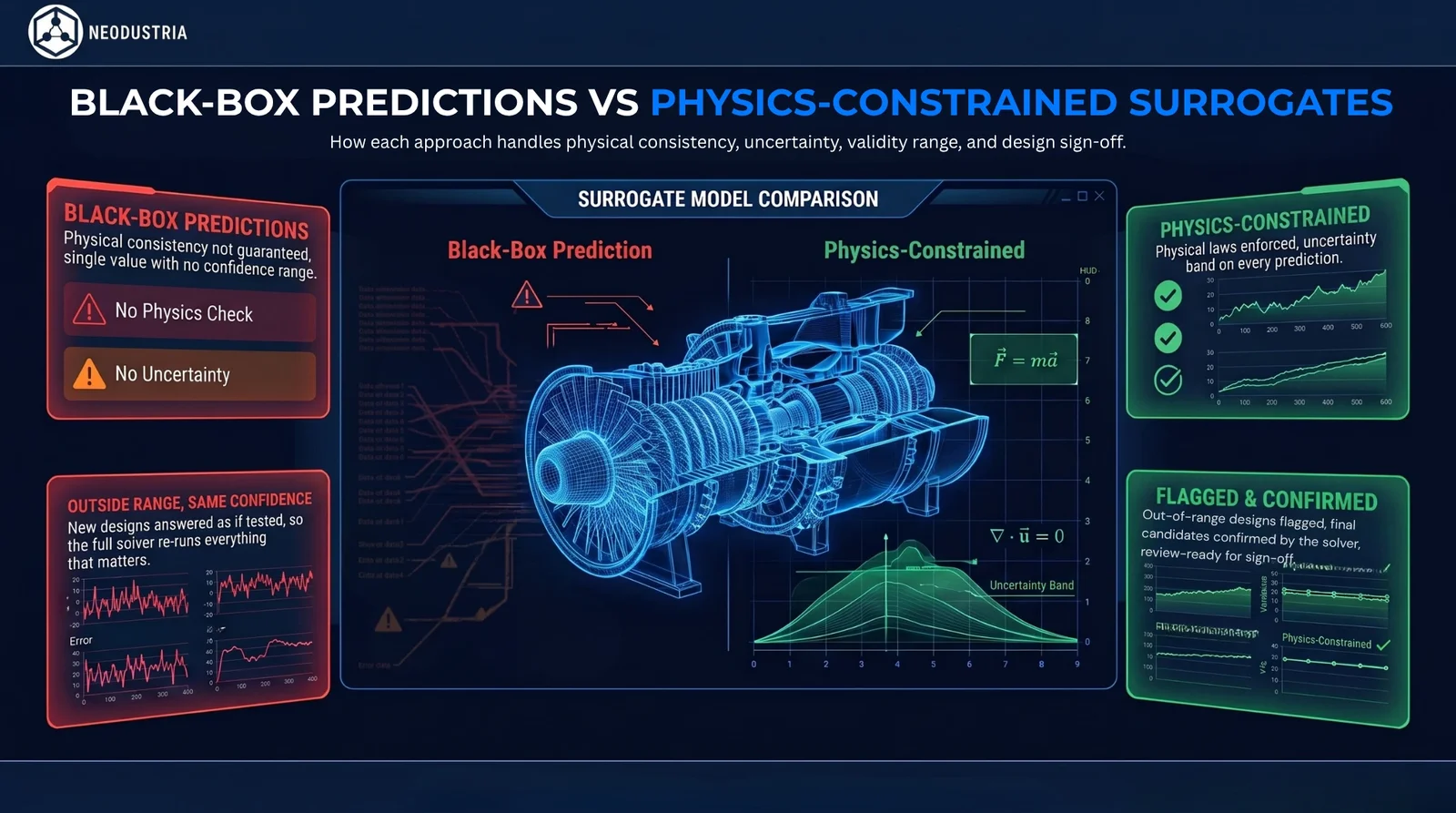
Black-box predictions versus physics-constrained surrogates, compared across physical consistency, uncertainty, and the role of the full solver.
Key Features
- Physics Intelligence built into every surrogate: Physical laws are part of every physics-aware engineering surrogate, not a check added afterwards.
- Uncertainty engineers can act on: Confidence ranges come with every result, so margins rest on evidence, not habit.
- Models that know their limits: Validity range checks stop silent extrapolation, the most common way fast models fail in design.
- Solvers used where they matter most: Classical simulation remains the reference for design validation, directed to the designs that need confirmation.
- Evidence ready for review: Every prediction stays linked to its decision, so the evidence can be presented when a design change needs approval.
Final Verdict
Fast engineering models only shorten design cycles when engineers can trust their results. Physics constraints, uncertainty bands, validity range checks, and solver confirmation turn a surrogate's output from an opaque number into evidence an engineer can inspect, sign off, and present for review. The change is not that models become faster. It is that the distance between a prediction and an approved design becomes shorter, in line with Neodustria's mission that every model and decision stays explainable, auditable, and safe.