
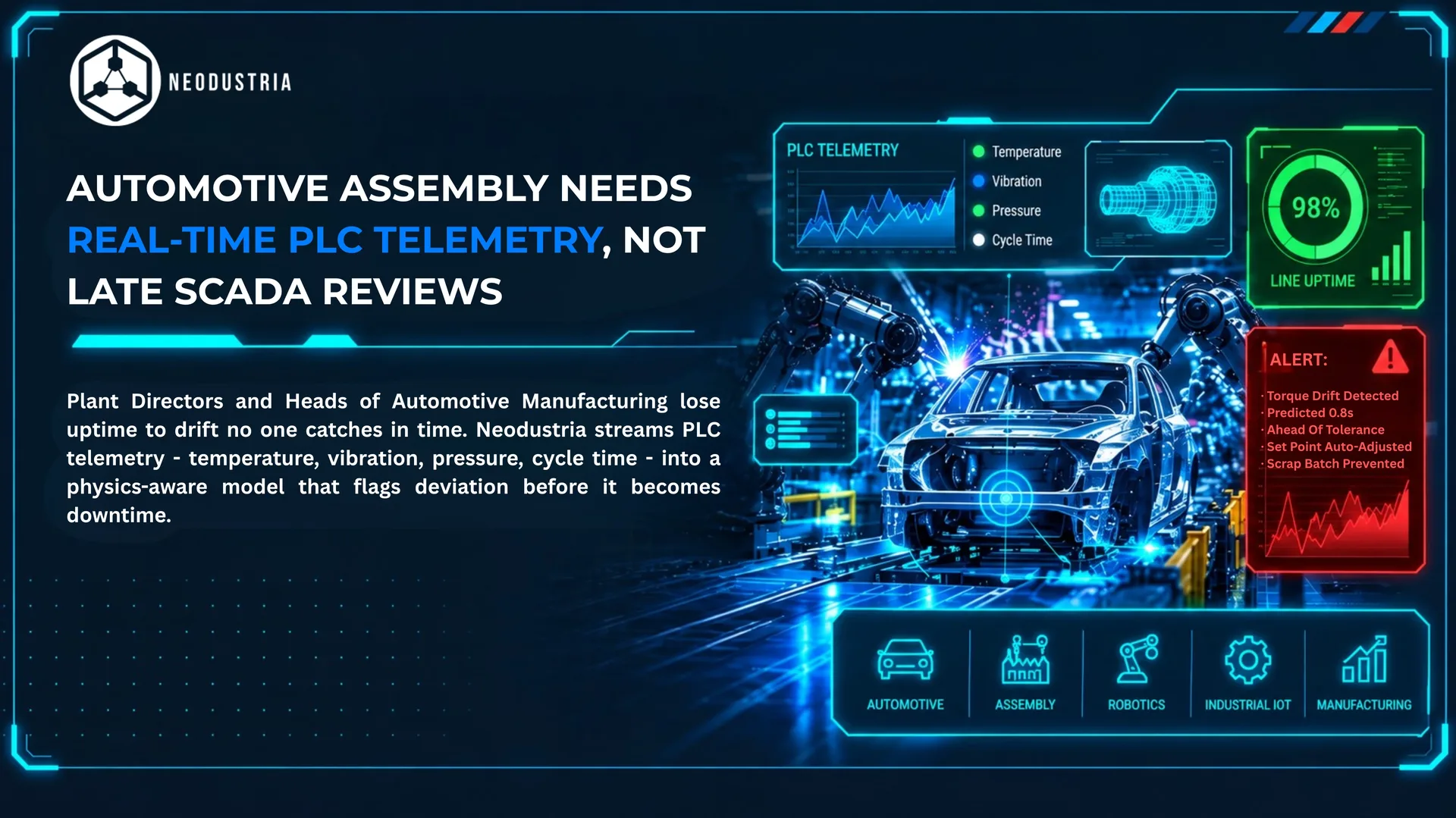
The line doesn't stop because of machine failure. It stops because of late decisions. Neodustria closes that gap with physics-aware neural surrogates that read SCADA telemetry and adjust parameters before drift becomes downtime.
Plant Directors and Heads of Automotive Manufacturing feel this pressure daily: defend yield, defend uptime, and do it while machine density keeps climbing. Add one more PLC, one more controller, one more execution system, and you've added one more place where a small deviation can quietly turn into a stopped line - peer-reviewed research on industrial PLC systems confirms this directly: each additional external computing layer "introduces latency between data collection and decision-making," while keeping processing closer to the controller reduces the number of places the system can fail (Zamora-Arranz et al., Results in Engineering, 2026). Nobody plans for this. It shows up as unplanned downtime, as yield nobody can account for, as rework that traces back - not to a broken machine - but to a decision that got there too late.
Why PLC-to-Execution Latency Is a Production Risk
PLC-to-execution latency is the time between four events: a deviation being detected in telemetry, an engineer diagnosing it, a parameter change being approved, and the correction being validated on the controller. Every minute added at any one of those four steps is a minute the line keeps running out of tolerance.
PLC controllers, SCADA systems, and MES (Manufacturing Execution System) platforms don't operate as separate systems on the plant floor - they behave as one execution chain, whether anyone designed them that way or not. In many automotive plants:
- Telemetry is logged faster than it can be interpreted, so deviations surface only after tolerance is already exceeded (industry alarm-management benchmarks put reliable operator handling at roughly one alarm per ten minutes in steady state - well below what SCADA systems generate during upset conditions, per EEMUA 191, the standard aligned with ISA-18.2 and IEC 62682)
- Parameter adjustments still route through manual review before reaching the controller
- SCADA and MES were built to log, display, and route approvals - not to run physics-aware closed-loop correction - so signals like torque, feed rate, temperature, position, force, cycle time, alarm codes, and quality results get recorded accurately but acted on too slowly
- Downtime events are diagnosed after the fact instead of prevented inside the control loop
This fragmented response chain compounds into unplanned downtime, yield loss, and asset fatigue across automotive cells. The scale is not abstract: Siemens/Senseye's "The True Cost of Downtime" research puts the cost of a single hour of unplanned downtime in an automotive plant above $2 million, and finds the average large plant still loses roughly a full day of production to it every month.
What High-Fidelity SCADA Telemetry Actually Requires
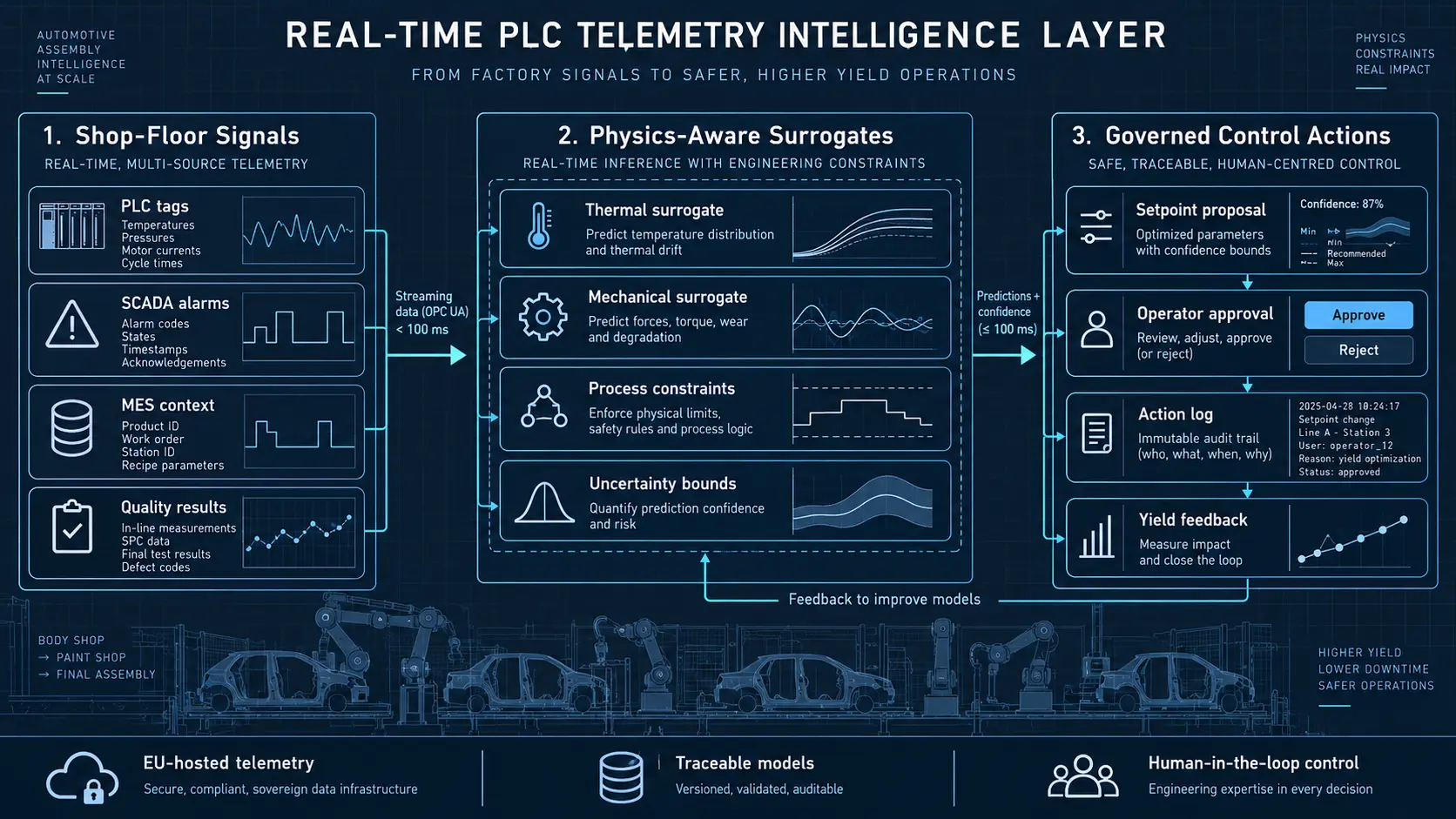
Neodustria's Unified Engineering Environment ingests high-fidelity SCADA telemetry directly into a physics-aware intelligence layer, giving engineering and operations a shared, real-time view of line behavior: the same signals SCADA already logs, acted on inside the control loop instead of reviewed after the fact.
By orchestrating telemetry, physics-aware models, and execution in one environment, Neodustria empowers automotive cells to detect drift inside the control loop itself, not after the fact.
Engineer Insight:
"I'd get the SCADA alert, pull up the trend, confirm it wasn't noise, then call it down to the floor. By the time all that was done, we were twelve minutes into a scrap run. The tooling never failed. My review step was the bottleneck."
Senior Automotive Manufacturing Engineer
The Solution: Physics-Aware Neural Surrogates on the Line
Neodustria's platform pairs high-fidelity SCADA telemetry with physics-aware neural surrogates trained on the mechanical and thermal behavior of the line. A surrogate's job is not to classify an alarm as normal or abnormal. Its job is to estimate the physical consequence of a reading before that consequence shows up as a defect: what a torque reading now means for a fastener's fatigue life later, what a temperature drift now means for tolerance in the next hundred parts. Instead of waiting for a threshold breach, the surrogates predict how a parameter drift will propagate and adjust the controller before tolerance is exceeded.
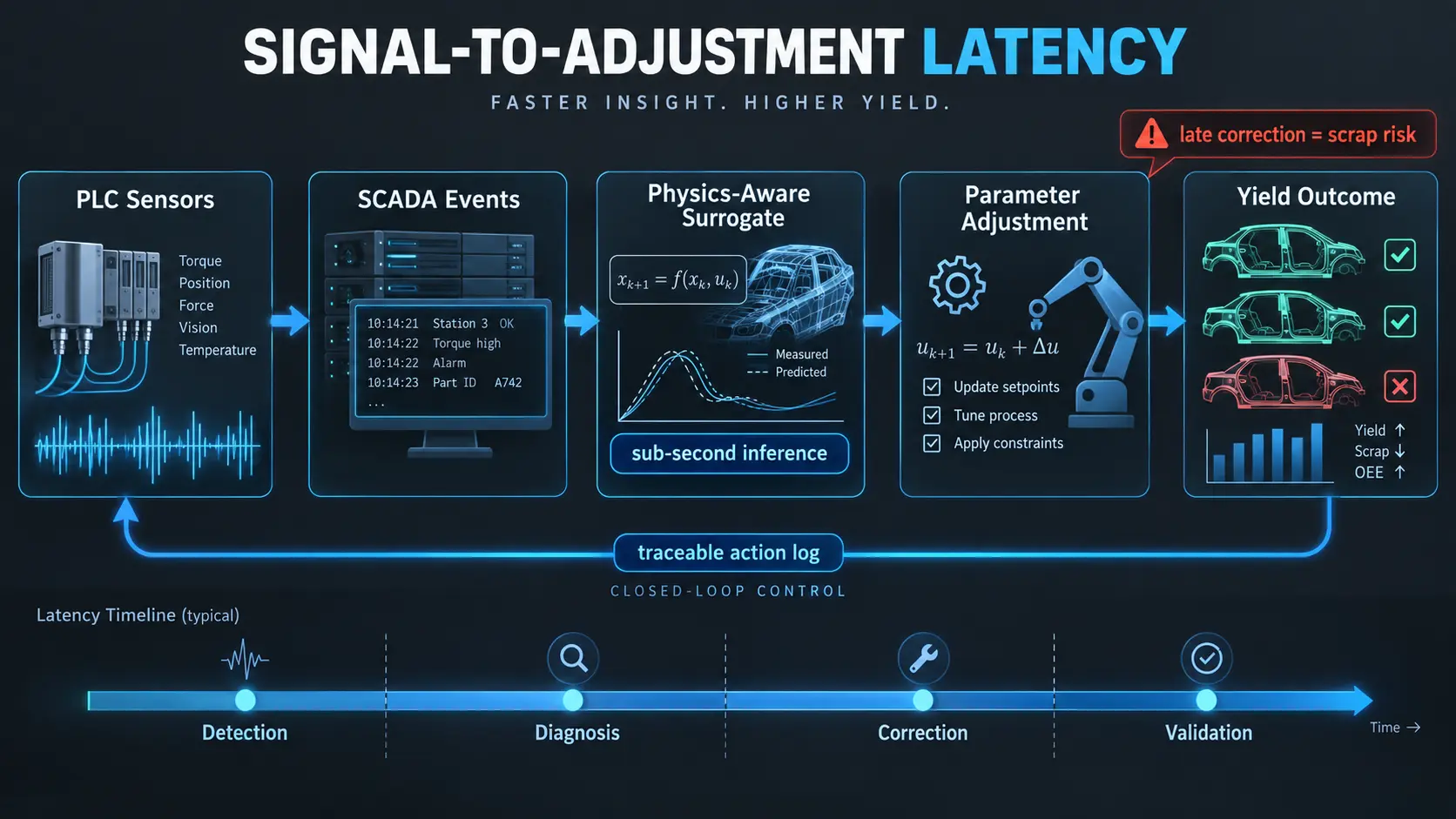
- Physics-aware neural surrogates process live telemetry from PLC and SCADA systems in parallel with production
- Parameter adjustments are computed and applied autonomously, inside the control loop, not after a manual review cycle
- Every adjustment is traceable across the Unified Engineering Data Fabric, linking control action back to design intent
- A Sovereign Industrial Cloud keeps telemetry, models, and adjustment history inside a single compliant environment
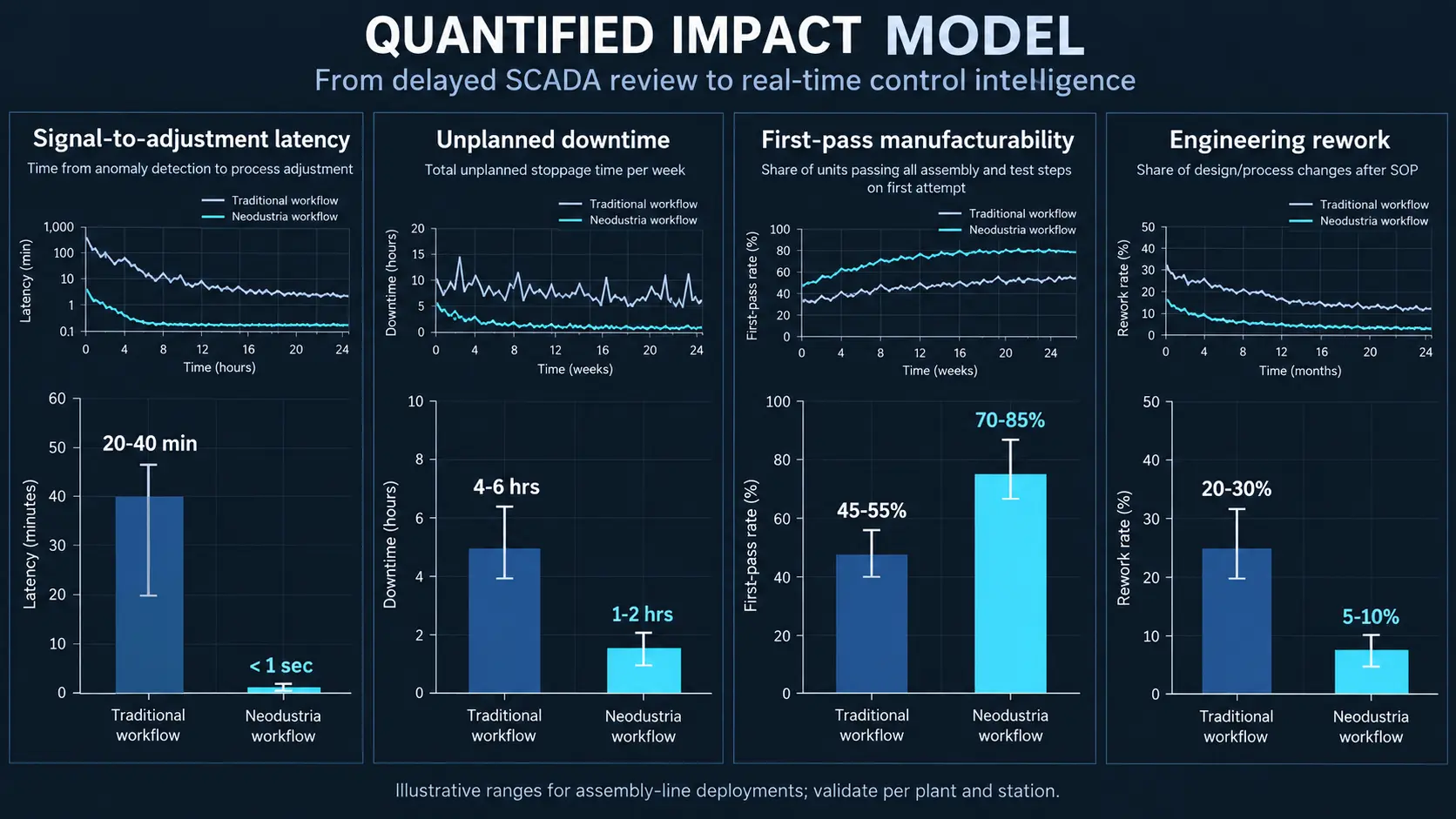
The table below models illustrative deployment ranges for this scenario, not a guarantee or a named benchmark:
| Aspect | Traditional Workflow | Neodustria Intelligence Workflow | Improvement |
|---|---|---|---|
| Signal-to-Adjustment Latency | 20–40 min | Sub-second | Reduced by ~99% |
| Unplanned Downtime (weekly) | 4–6 hrs | 1–2 hrs | Reduced by ~60% |
| Manual Review Cycles per Incident | 1–2 | 0 | Eliminated |
| First-Pass Manufacturability | 45–55% | 70–85% | +20–30% |
| Engineering Rework | 20–30% of total time | 5–10% | Reduced by ~65% |
Figures are illustrative deployment ranges for a typical assembly line, not an absolute claim or a named pilot result; exact figures will vary by plant. The downtime-cost scale is consistent with the Siemens/Senseye research cited earlier in this piece.
This connectivity allows automotive assembly lines to close the signal-to-adjustment gap, protect yield, and hold first-pass manufacturability steady as machine density increases.
Mini Case Study: Closing the Latency Gap on a Stamping Line
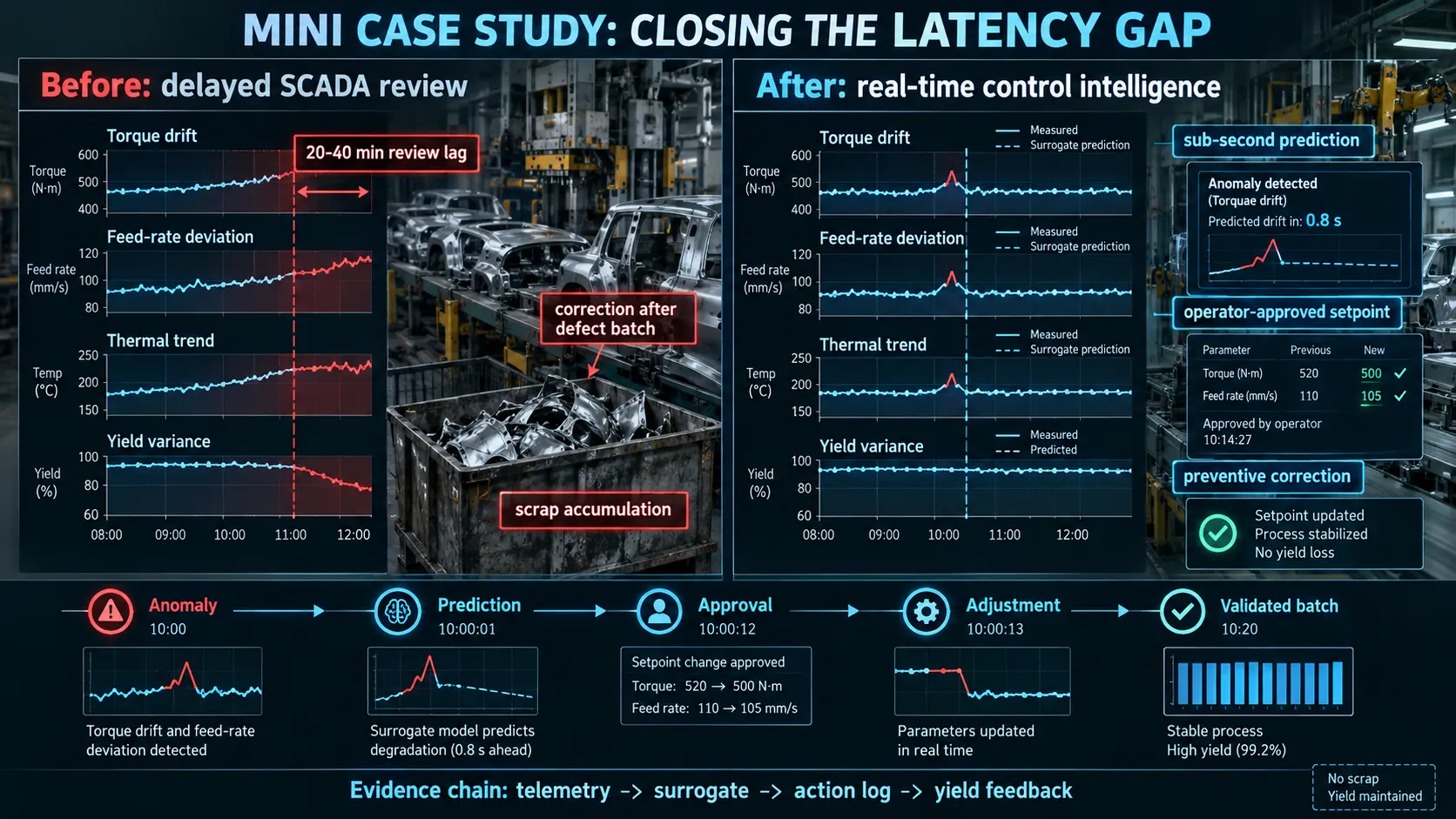
A mid-sized automotive stamping plant was losing an average of 4 hours of production per week to unplanned stoppages traced back to late-detected torque and feed-rate drift. Manual review of SCADA alerts added 20–40 minutes between detection and correction on every incident.
The evidence chain Neodustria closes looks like this: telemetry reading → surrogate prediction → operator approval → setpoint update → yield feedback confirming the correction held. Every link stays traceable; only the time between links changes.
Engineer Insight:
"We used to find out about drift the same way everyone does: a batch failed final inspection, and someone went back through the logs to figure out when it started. By the time we knew, we'd already made a few hundred bad parts."
Stamping Line Process Engineer
Real-Time Control: Human + Industrial Intelligence Working the Same Loop
Autonomous parameter adjustment is not automation at any cost. It is Industrial Intelligence working alongside plant engineers, inside the same control loop, with every adjustment traceable back to physical constraints. These figures track directly with what Neodustria reports across its Automotive vertical more broadly: a 40% validation cycle reduction and 2x manufacturing throughput.
Key Features of Neodustria's Real-Time Control Layer
High-Fidelity Telemetry Ingestion
Continuous, high-resolution ingestion from PLC and SCADA systems, synchronized with the Unified Engineering Data Fabric so no signal is sampled too coarsely to matter.
Physics-Aware Neural Surrogates
Engineering surrogates trained on the mechanical and thermal behavior of the line, predicting how drift will propagate before it reaches tolerance.
Autonomous Parameter Adjustment
Adjustments are computed and applied inside the control loop, removing the manual review step that turns a small deviation into a stopped line.
Sovereign Industrial Cloud
Telemetry, models, and adjustment history stay inside a single, compliant, EU-hosted environment, fully traceable for audit and engineering review.
Deploy control at the speed the line actually runs. This is no longer "detect, then correct." This is designing with the correction built in.
Final Verdict: Compress the Loop Between Signal, Decision, and Correction
That's the real shift Neodustria makes in automotive assembly: compressing the loop between signal, decision, and correction, not managing each stage better in isolation. Physics-aware neural surrogates sit directly in the PLC-to-execution chain, and Platform 1.0's single digital thread turns real-time SCADA telemetry into autonomous physics simulation at the control loop itself. The same four steps still happen: detection, diagnosis, approval, correction; they just happen inside one loop instead of across four handoffs.