
Executive Summary
Aerodynamics determines up to 40% of EV range. Yet traditional CFD pipelines remain too slow to explore enough design variability. A global Tier-1 supplier used Neodustria to:
Neodustria's Physics-Aware Surrogate Engine fused 3D geometry embeddings, surface graph networks, physics-guided turbulence learning, and ontology-driven linkage across materials, geometry, and historical CFD → Delivering CFD-level accuracy at near-instant speed.
Business Context & Strategic Impact
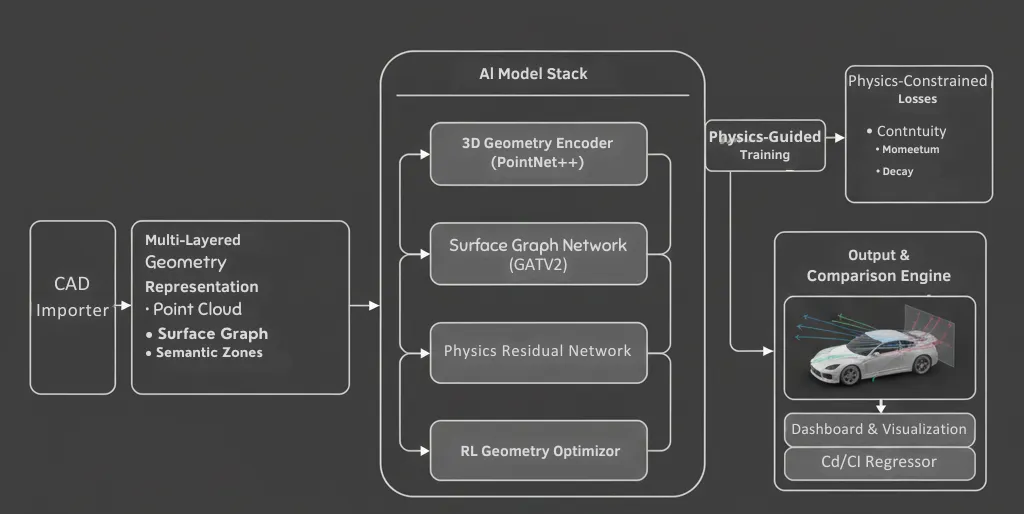
Neodustria’s aerodynamics intelligence stack integrated in the OEM workflow.
The Challenge
OEM aerodynamic teams face a structural bottleneck:
- CFD is slow (1 simulation = 20–50 hours)
- Meshing requires rare expertise
- Geometry exploration is limited
- HPC clusters remain saturated
- Only 2–4 designs/week can be tested
EV Market Demands
In parallel, the EV market demands:
- Aggressive range improvements
- Low energy loss
- Reduced aerodynamic noise
- Compliance with WLTP/SAE test cycles
Scientific Foundation of Neodustria's Aerodynamics Engine
Multi-Layered Geometry Representation
Neodustria converts CAD/STEP into a multi-representation set:
- Point Cloud (512k–2M points)
- Surface Mesh Graph (nodes + edges + curvature metrics)
- Semantic Zones (mirrors, hood, roof, wheelhouses, A-pillar, diffuser)
- Material attributes (polymers, metals, composites)
- Flow region ontology (pressure zones, wake, stagnation points)
This allows ML models to understand shape + physics + semantics.
Physics-Aware Model Stack
Architecture Components
- CAD Importer
- 3D Geometry Encoder (PointNet++)
- Surface Graph Network (GATv2)
- Physics Residual Network (Navier–Stokes priors)
- Flow Field Predictor
- Cd/Cl Regressor
- RL Geometry Optimizer
- Dashboard & Comparison Engine
Physics Constraints Used
Neodustria embeds:
- Continuity equation
- Momentum Navier–Stokes residual losses
- Turbulence surrogate constraints
- Pressure field consistency loss
- Boundary-layer gradient penalties
- Wake decay coherence
This preserves physical behaviour even when extrapolating.
Quantitative Results
Aerodynamic Performance Gains
| Metric | Baseline | Optimized | Improvement |
|---|---|---|---|
| Drag Coefficient (Cd) | 0.286 | 0.234 | -18.2% |
| EV Range (WLTP) | 420 km | 453 km | +7.8% |
| Energy Consumption | 18.2 kWh/100km | 16.8 kWh/100km | -7.7% |
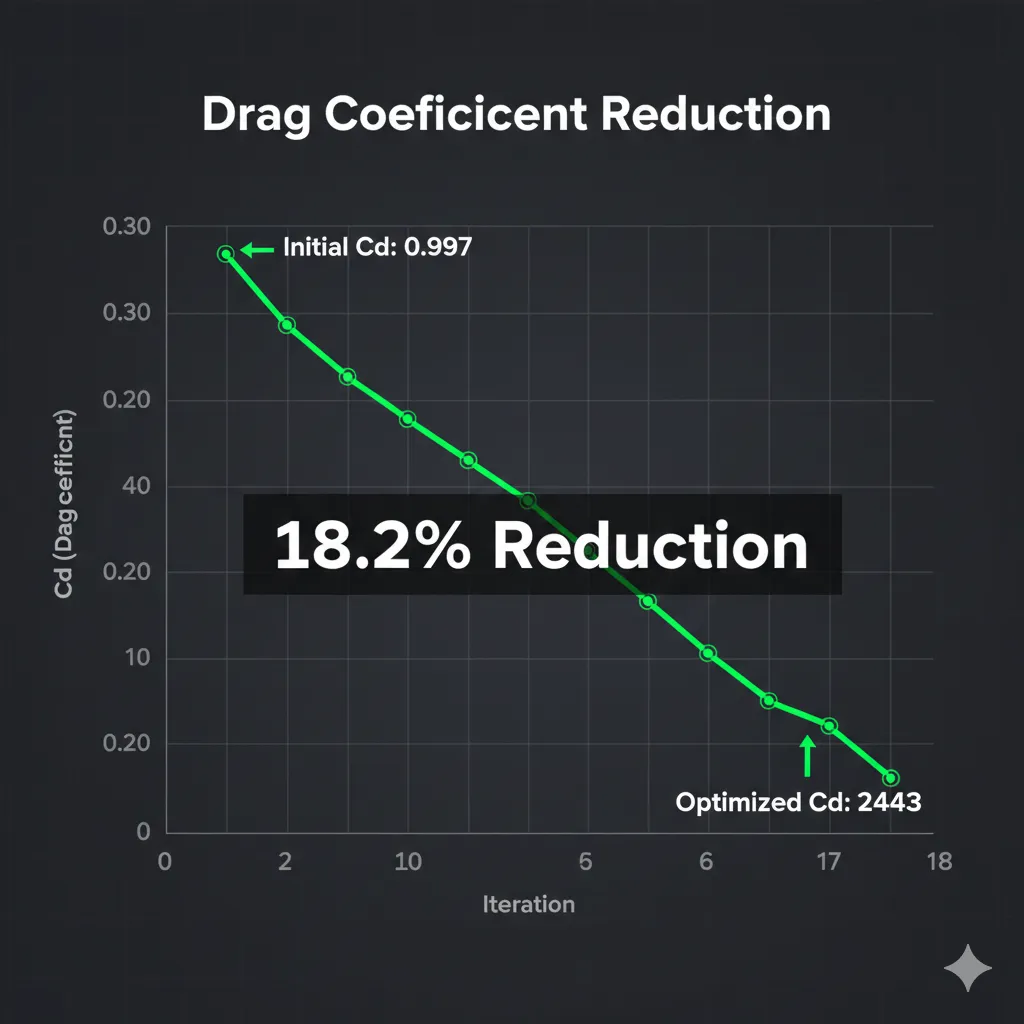
Drag coefficient reduction across baseline and optimized EV design.
Iteration Velocity
| Step | Traditional CFD | Neodustria | Acceleration |
|---|---|---|---|
| Geometry Cleanup | 3h | 10 min | ×18 |
| Meshing | 6h | 0 min | ∞ |
| Solver Runtime | 30–50h | 5–12 min | ×300–500 |
| Post-processing | 3h | 30 sec | ×360 |
| Total | 45h | 8 min | ×337 speedup |
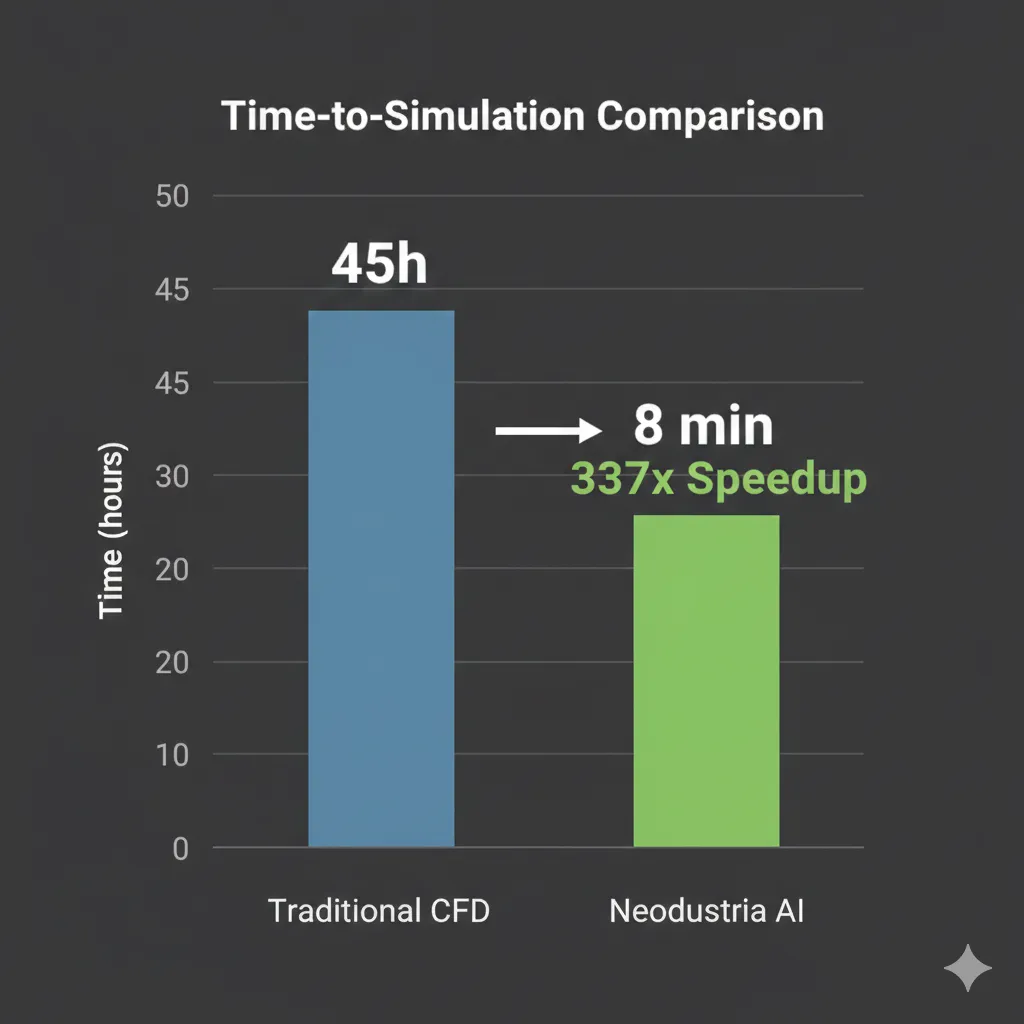
Time-to-simulation comparison: traditional CFD vs Neodustria’s physics-aware industrial intelligence.
Visualization Suite
Neodustria provides a full visualization suite to compare baseline and optimized designs, making drag reduction decisions auditable and explainable.
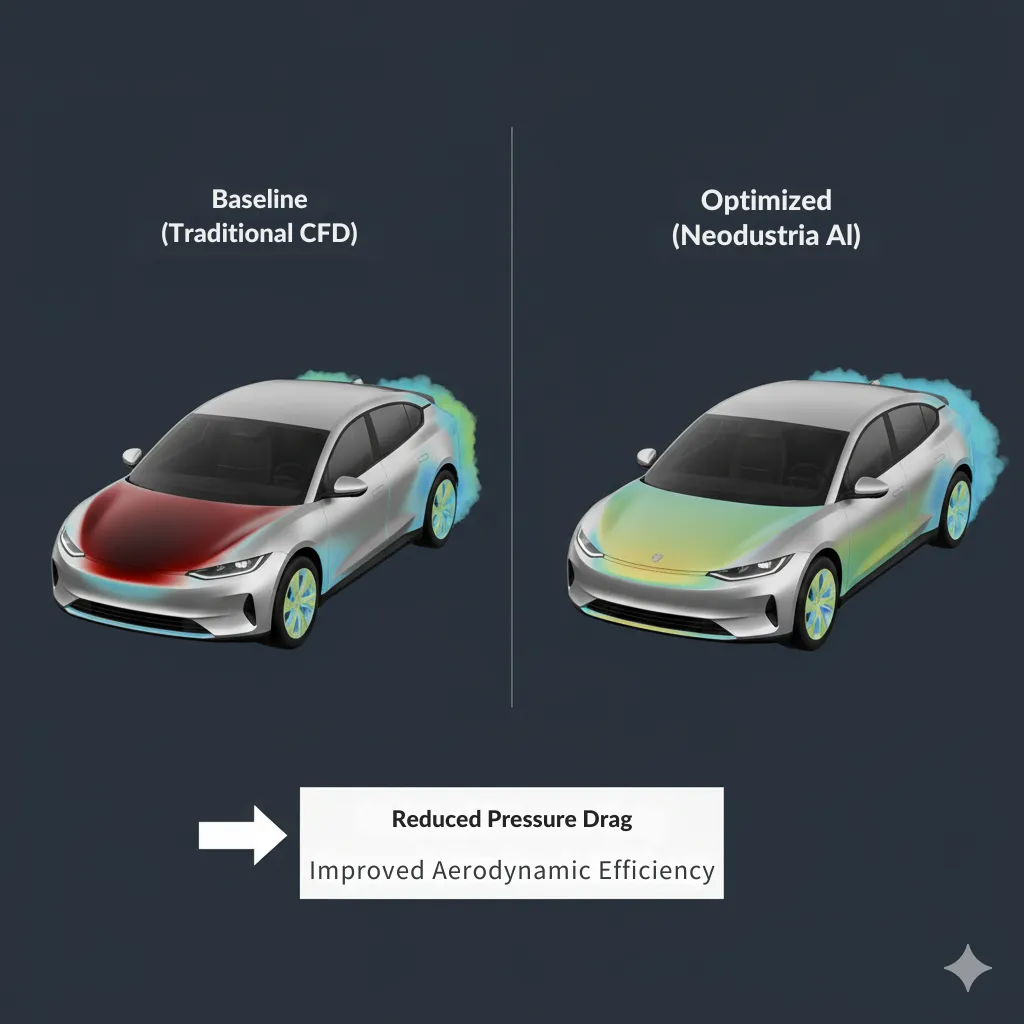
Pressure distribution map – reduced high-pressure zones driving lower drag.
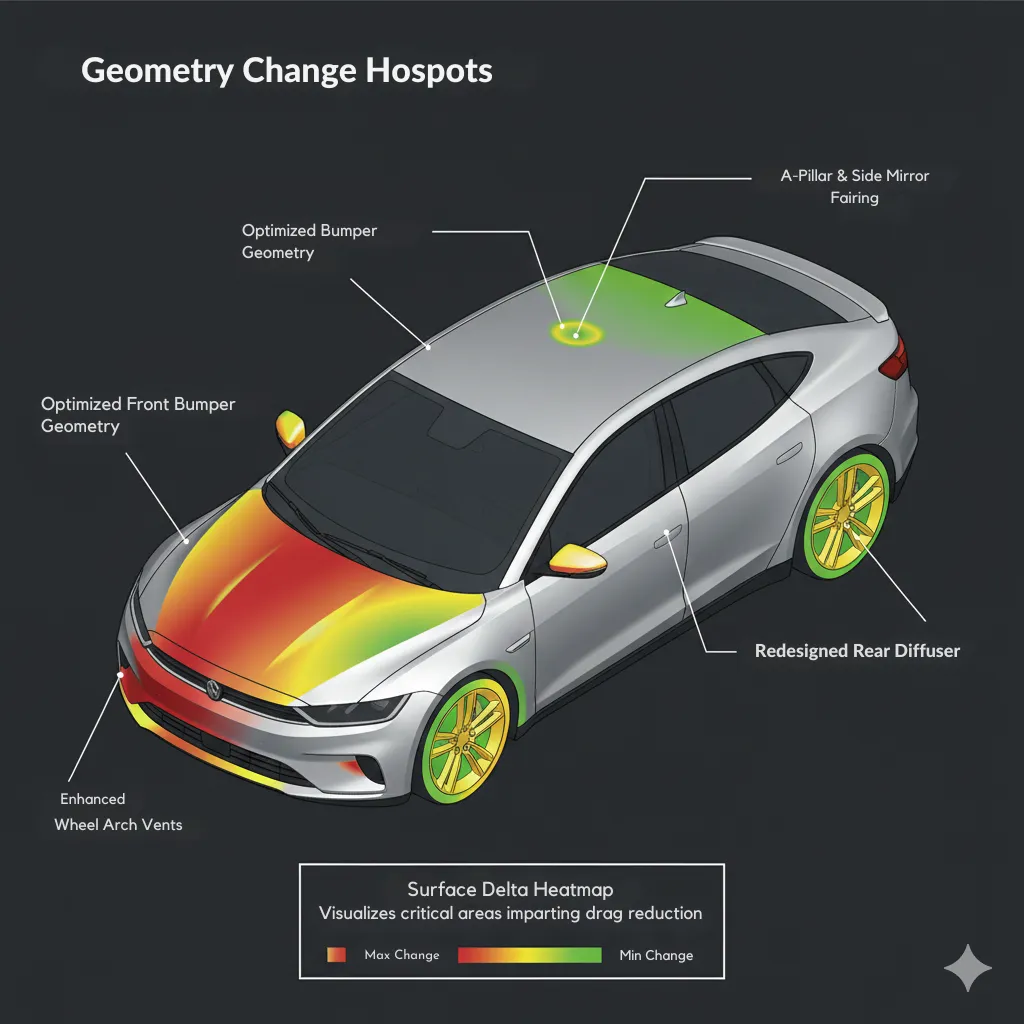
Geometry change hotspots – A-pillar, underbody and diffuser refinements with highest Cd impact.
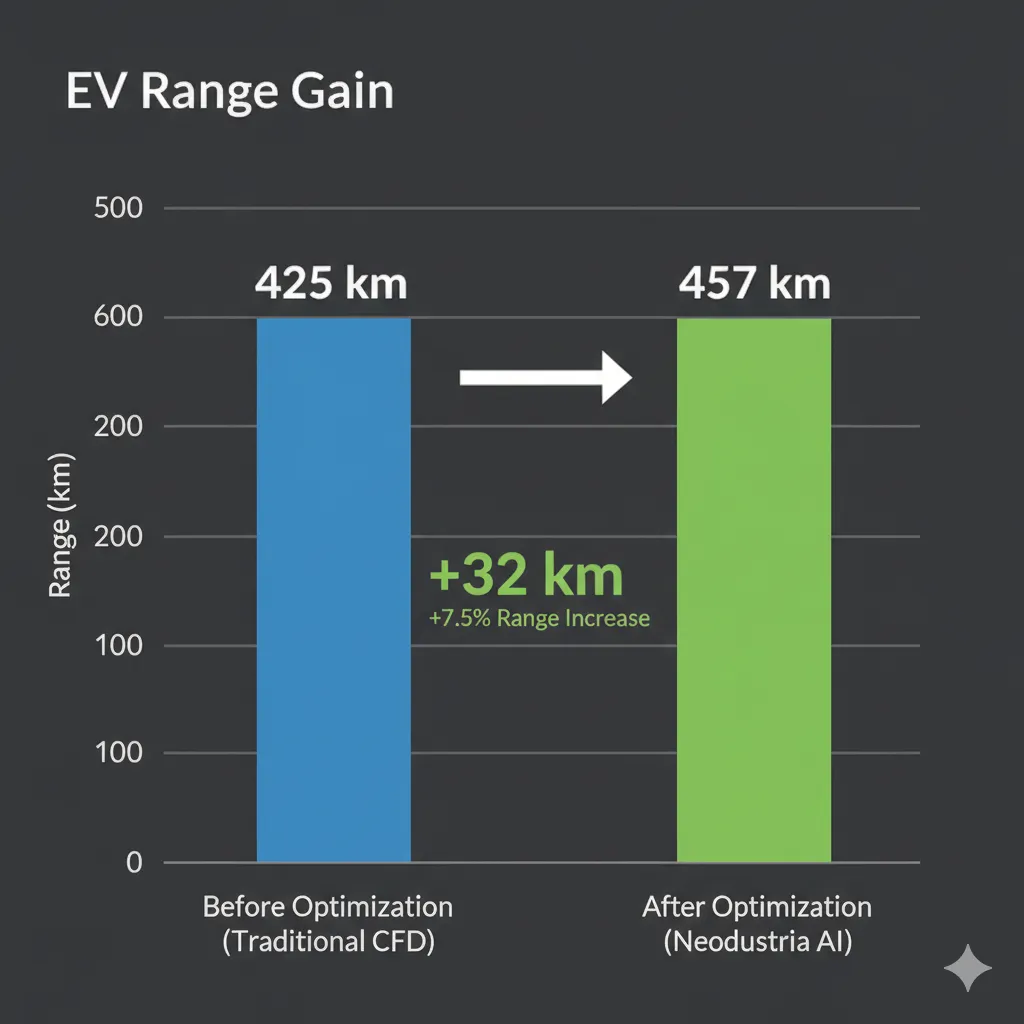
EV range gain visualization – WLTP range improvement from aerodynamic optimization.
Engineering Methodology
Dataset Composition
- 3920 CFD simulations
- 14 EV platforms
- 800+ aerodynamic feature categories
- 5–20M mesh cell resolution
- Dataset normalized via Neodustria's ontology
Training Strategy
- 70/20/10 split
- Multi-task losses
- Physics-constrained training
- 3D augmentation (scaling, curvature randomization)
- Surface graph augmentation
Business Impact for Tier-1 / OEM
"With Neodustria we redesigned an entire aerodynamic package in one afternoon. We previously needed 4–6 weeks."
— Head of Aerodynamics & EV Platform, Top-10 Tier-1
Why Research Labs Engage
Neodustria's respirable architecture supports:
- Academic research on 3D ML + physics models
- Co-publication opportunities
- Advanced CFD curriculum replacement
- High-speed surrogate simulation education
- Real-world industrial dataset access
Potential Partnerships
Leading Research Institutions
- MIT AeroAstro
- TU Munich
- KAUST
- Polytechnique Montréal
- KAIST
- CentraleSupélec
Deployment Model
Neodustria Aerodynamics Workflow Integration Options
- Direct CAD APIs: Autodesk, Siemens, Dassault, PTC
- Secure cloud: Sovereign, On-Prem, Hybrid
- Multi-tenant engineering cell setup
Conclusion
Neodustria transforms aerodynamics from a limiting factor into an innovation engine:
- From scarce simulations → abundant instant predictions
- From HPC bottlenecks → real-time optimization
- From manual workflows → smart linked data
- From intuition → quantitative intelligence
This is more than simulation acceleration. It is the future of automotive engineering intelligence.