
Executive Summary
Aerospace supply chains are not failing due to poor supplier capability. They fail due to loss of engineering governance across distributed operations.
Across large aerospace programs:
- ⬢ 27% of schedule delays originate from supplier-side process deviations
- ⬢ 22–35% of quality escapes are traced to late or inconsistent standard enforcement
- ⬢ Corrective actions are typically initiated 2–4 weeks after the deviation occurs
A global aerospace OEM deployed Neodustria Precision Industrial Intelligence to re-establish engineering-grade governance across Tier-1, Tier-2, and Tier-3 suppliers.
Neodustria replaces audit-era governance with continuous engineering control: standards become constraints, execution becomes observable, and drift becomes detectable before it materializes into rework.
Business Context & Strategic Impact
Modern aerospace programs operate under conditions that amplify risk:
- ◆ Multi-continent supplier networks
- ◆ Safety-critical tolerances with low defect thresholds
- ◆ Shared suppliers across concurrent programs
- ◆ Regulatory exposure at every production stage
Compounding Industrial Risk
▢ No unified visibility into supplier execution state
▢ Standards interpreted differently across facilities
▢ Engineering changes propagated inconsistently
Late discovery of deviations during final integration
▢ Fragmented quality data across Tier-1 to Tier-3 suppliers
▢ Lack of real-time deviation escalation mechanisms
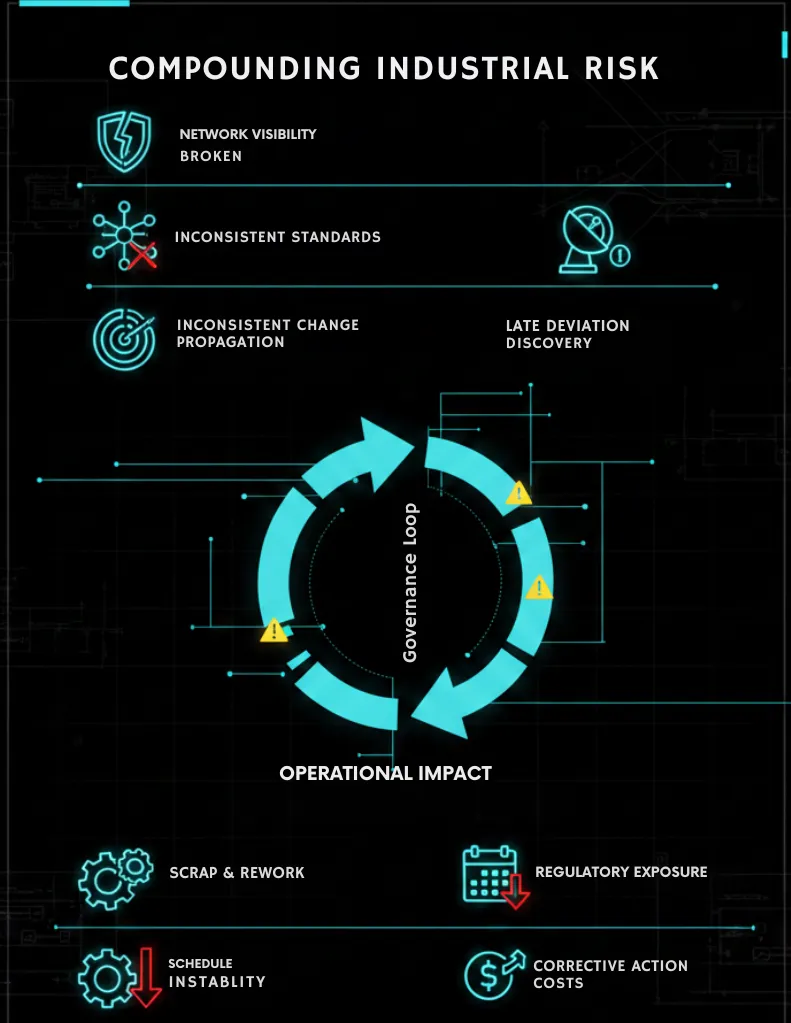
This was not an Operational Divergence. It was a governance breakdown.
Operational Pain
- Supplier execution is invisible between audits
- Standards drift across facilities and programs
- Engineering changes propagate inconsistently
- Late discovery during integration creates unrecoverable rework
- Escalations occur weeks after the deviation forms
Program Demands
- Continuous governance across Tier-1 to Tier-3
- Auditability by design, not by paperwork
- Early drift detection with engineering evidence
- Standard enforcement as operational constraints
- Stable execution under change
Neodustria’s Solution: Precision Industrial Intelligence for Aerospace Governance
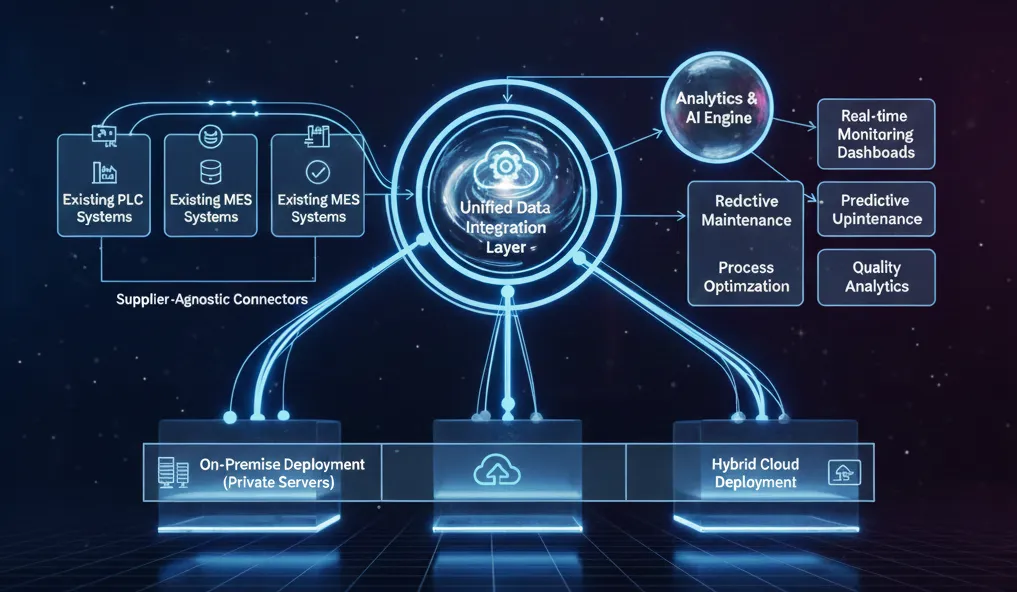
The Neodustria Nexus establishes a single physics-aware intelligence layer, unifying supplier MES, PLC, quality signals, and high-fidelity telemetry into a Sovereign Industrial Cloud.
- Cells focus on specific governance and intelligence functions
- Neurons process high-fidelity operational signals from across the supply chain
- Cell leaders and intelligence architects define and maintain engineering-grade governance logic
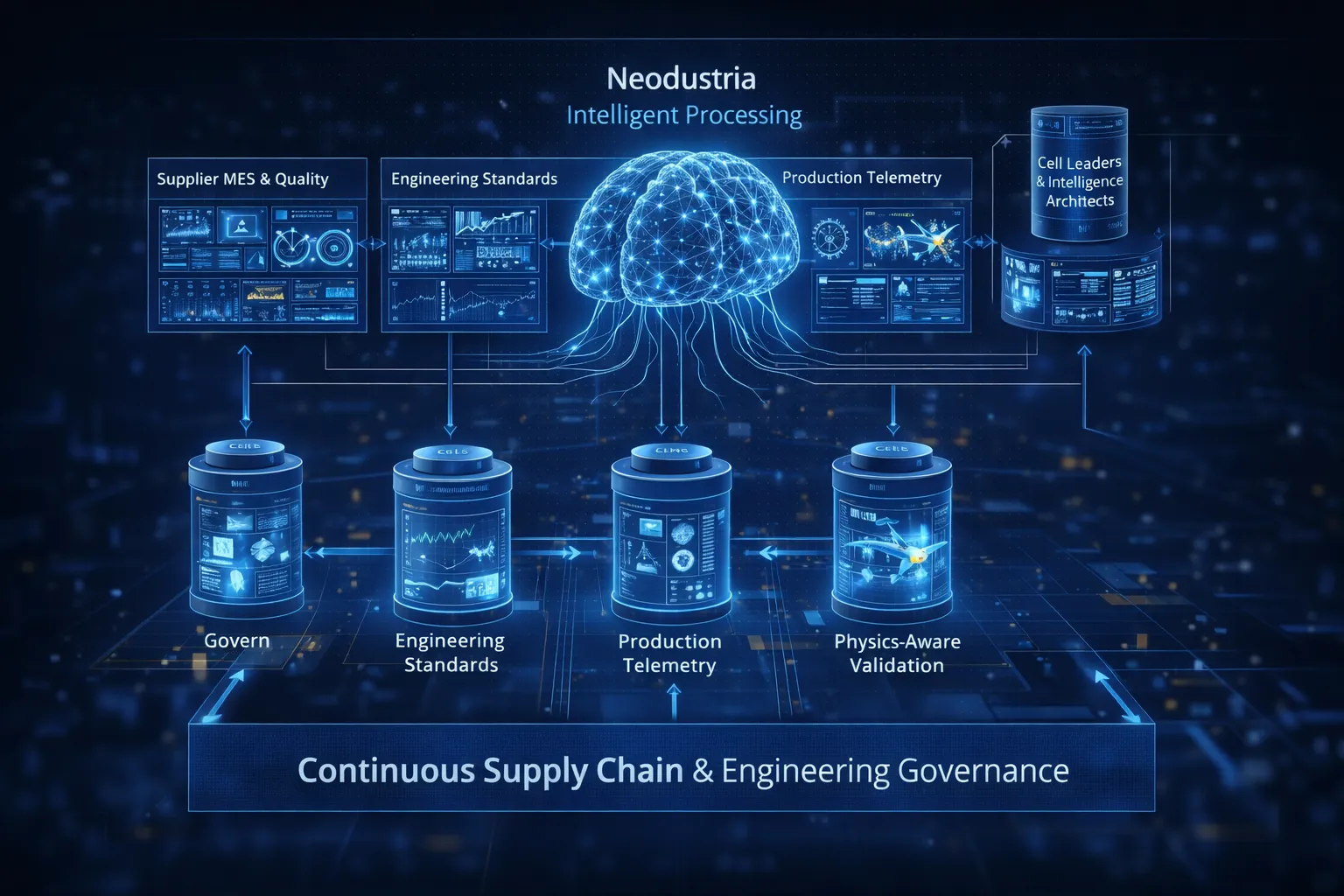
- Supplier MES and quality systems
- Engineering standards and constraints
- High-fidelity production telemetry
- Physics-Aware Validation representations of execution reality
Governance Capabilities Deployed
Continuous Supplier Execution Visibility
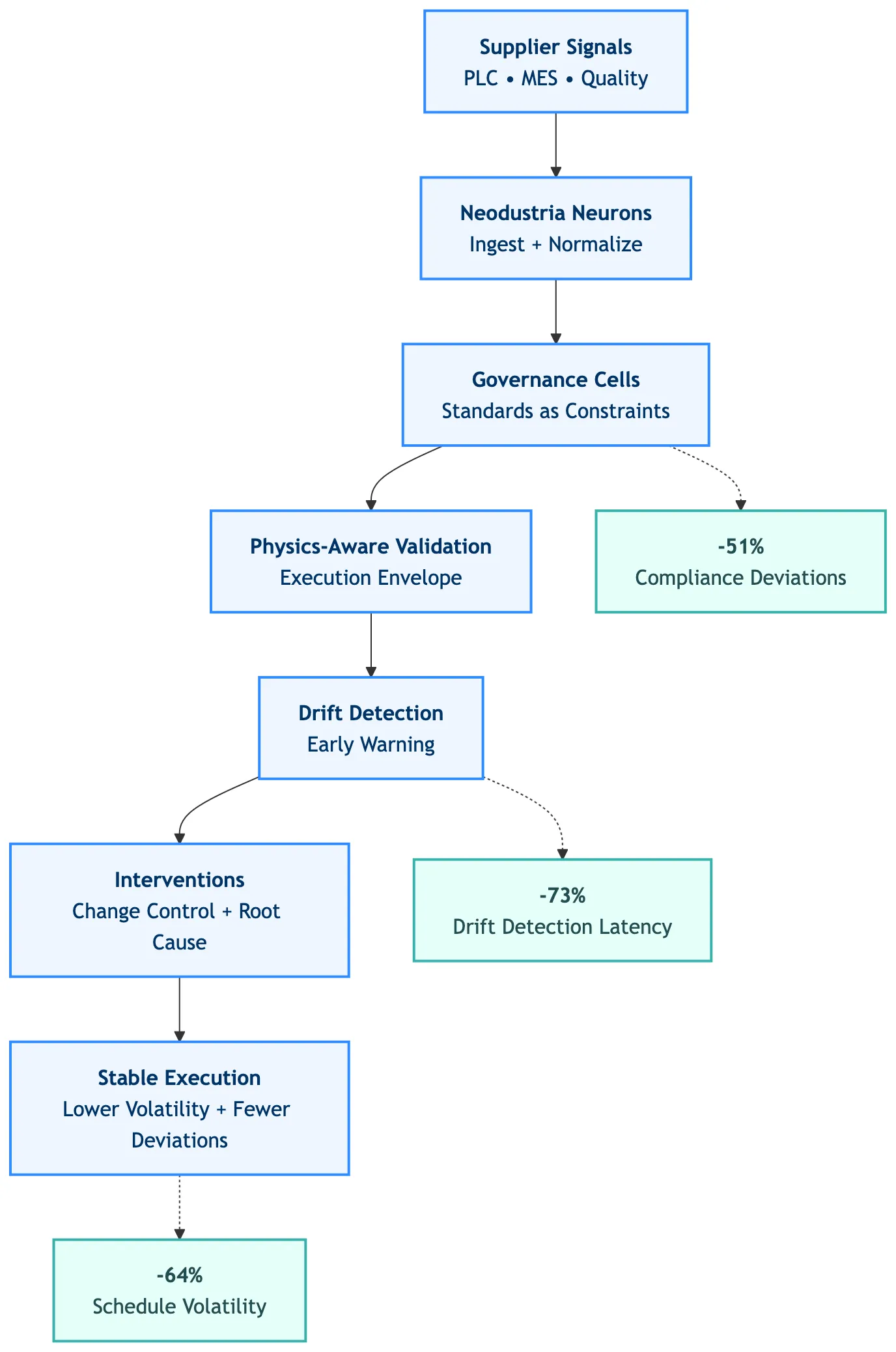
Neodustria neurons ingest real-time execution signals across suppliers, enabling governance cells to observe deviation as it forms.
Supplier visibility increased from 38% to 94% across active programs.
Engineering-Grade Standard Enforcement
Instead of relying on documents, Neodustria enforces standards as operational constraints, aligned with aerospace engineering requirements.
51% reduction in compliance deviations detected after production.
Early Detection of Engineering Drift
Physics-aware models and physics-aware validation identify divergence from approved execution envelopes before physical impact occurs.
Deviation detection time reduced by 73%.
Controlled Change Propagation
Engineering changes are governed centrally and propagated consistently, eliminating silent divergence across suppliers.
92% reduction in untracked supplier-side change.
From Late Discovery to Governed Execution
With Neodustria, drift is detected early and linked to engineering constraints — transforming governance from reactive escalation into continuous control.
- ◆ Detect drift while it is forming
- ◆ Trace deviation to root engineering constraints
- ◆ Prioritize interventions by program criticality
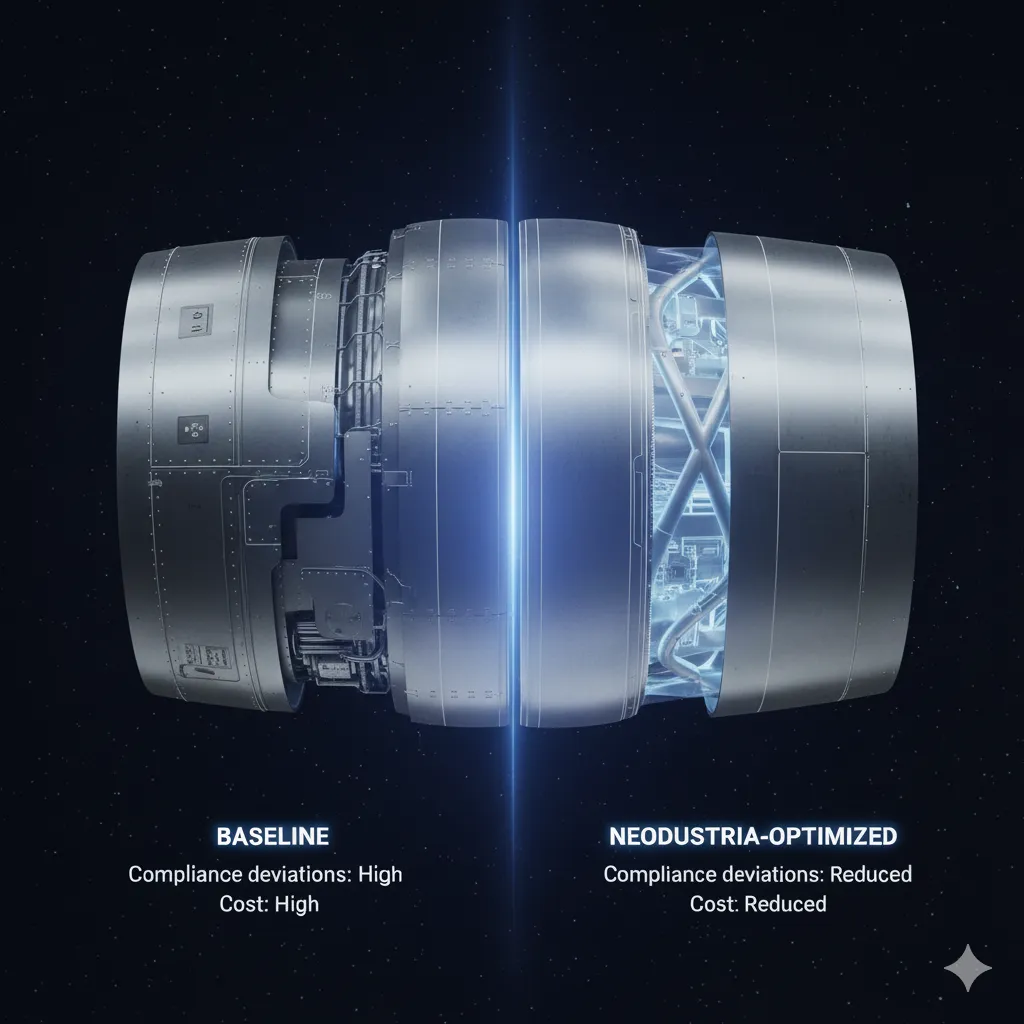
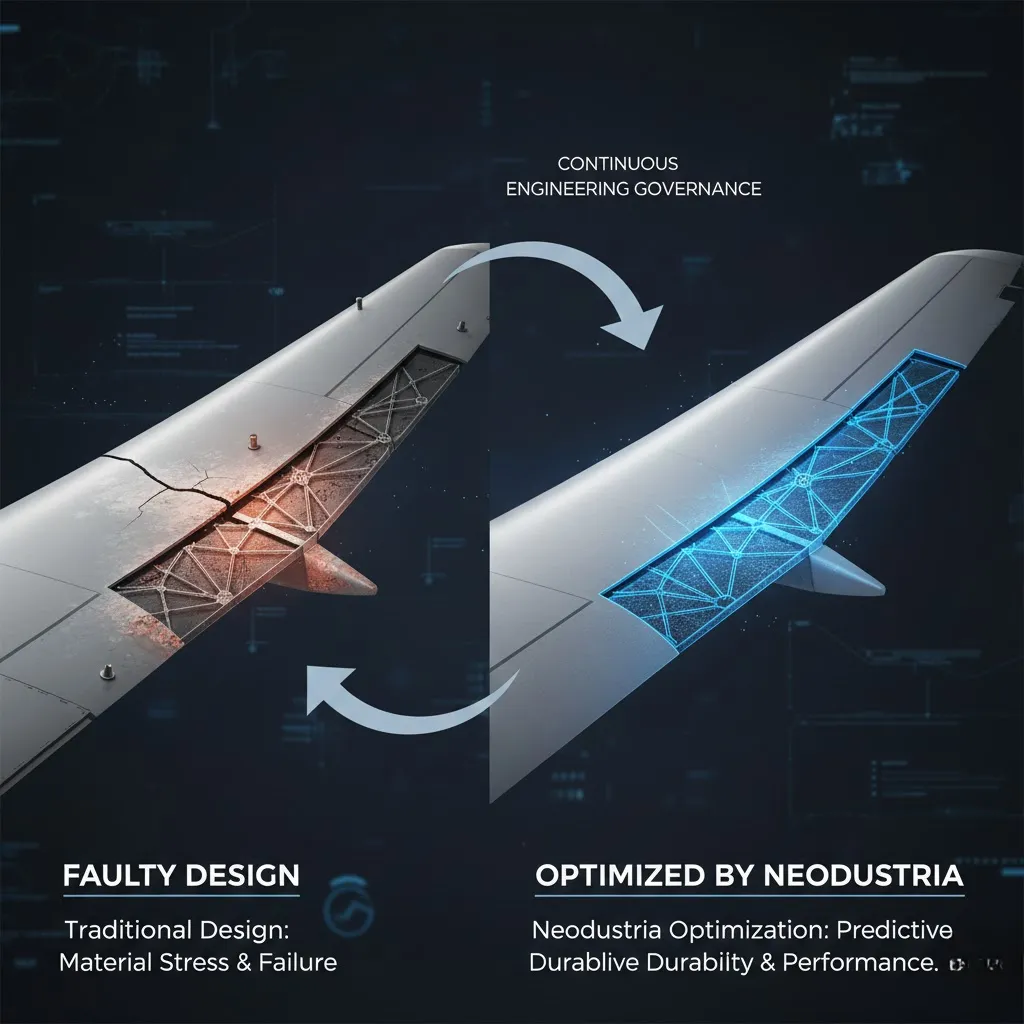
Continuous engineering governance shift: from late-stage failure modes to Neodustria-optimized, predictive control.
Quantitative Results
| Metric | Legacy State | Neodustria State | Impact |
|---|---|---|---|
| Supplier execution visibility | 38% | 94% | +56 pts |
| Compliance deviations | High | Reduced | -51% |
| Production volatility | High | Lower | -64% |
| Drift detection latency | Weeks | Days | -73% |
| Untracked supplier-side changes | Frequent | Near-zero | -92% |
Visualization & Governance Intelligence
- ▣ Supplier Execution Heatmaps: highlight deviation risk across programs and facilities
- ▣ Constraint Adherence Indicators: show alignment with engineering and quality envelopes
- ▣ Change Engineering Certainty Views: track how engineering updates propagate across suppliers
These views support cell leaders and intelligence architects in maintaining operational control.
Validation Scope & Methodology
- ▣ 110+ global suppliers
- ▣ Tier-1 to Tier-3 aerospace manufacturing
- ▣ Safety-critical assemblies
- ▣ Multiple concurrent aircraft programs
Success was measured by:
- ➕ Reduction in late-stage intervention
- ➕ Stability of execution under change
- ➕ Predictability of supplier performance
Supplier-agnostic connectors ingest PLC/MES/Quality signals without disrupting live aerospace programs.
Business Impact
Voice of the Program
“We no longer discover risk during audits. We govern execution while it is happening.”
— Supply Chain Leader, Global Supply Chain Governance
- ▣ Reduced rework and escalation by catching drift early
- ▣ Higher confidence in supplier compliance through continuous enforcement
- ▣ Predictable execution across programs with governed change propagation
- ☰ Clear evidence trails for engineering decisions
- ☰ Faster time-to-action when deviations appear
- ☰ Lower exposure during integration and certification phases
Governance Loop