

Executive Summary
By implementing Neodustria’s Hyperspeed ROI Deployment Model, a global naval engineering authority achieved immediate and measurable outcomes across fleet maintenance, diagnostics, and mission readiness.
Neodustria’s Naval Intelligence Engine combines system-graph learning, predictive maintenance, fuel/load optimization, and physics-informed constraints to deliver engineering-grade reliability—at fleet scale.
The Challenge: Legacy Systems, High Costs & Unpredictable Failures
Naval operations complexity: ageing subsystems, manual diagnostics, and limited “what-if” analysis capability.
Operational Pain
- Ageing electric & mechanical subsystems
- Heavy maintenance dependencies
- Manual diagnostics and error-prone checks
- Rising fuel, labor, and maintenance costs
- Unpredictable system failures and downtime
Mission Risk
- High downtime and mission disruption
- Frequent system failures
- Massive wasted labor
- No predictive visibility across fleet operations
- Limited ability to test multiple configurations (“what-if”)
Scientific Foundation
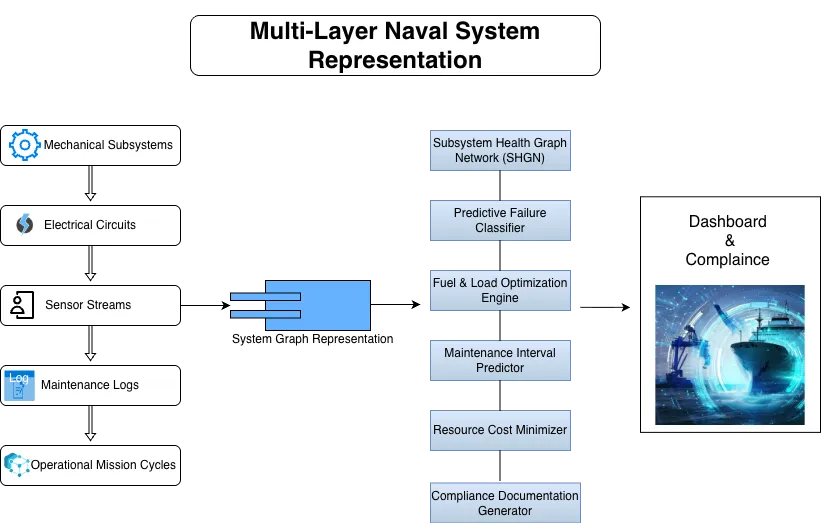
Multi-Layer Naval System Representation
Neodustria transforms naval subsystem data into a multi-layer system graph, enabling predictive insights and engineering intelligence across the fleet.
- Mechanical subsystems: propulsion, pumps, HVAC, generators
- Electrical circuits: load balance, power distribution, overload patterns
- Sensor streams: temperature, vibration, pressure, torque
- Historic maintenance logs: failures, repairs, operational notes
- Operational mission cycles: schedules, stress points, operating regimes
Naval Intelligence Engine
The engine converts the multi-layer system graph into actionable decisions that reduce cost, prevent failure, and increase readiness.
Core Components
- Subsystem Health Graph Network (SHGN)
- Predictive Failure Classifier
- Fuel & Load Optimization Engine
- Maintenance Interval Predictor
- Resource Cost Minimizer
- Compliance Documentation Generator
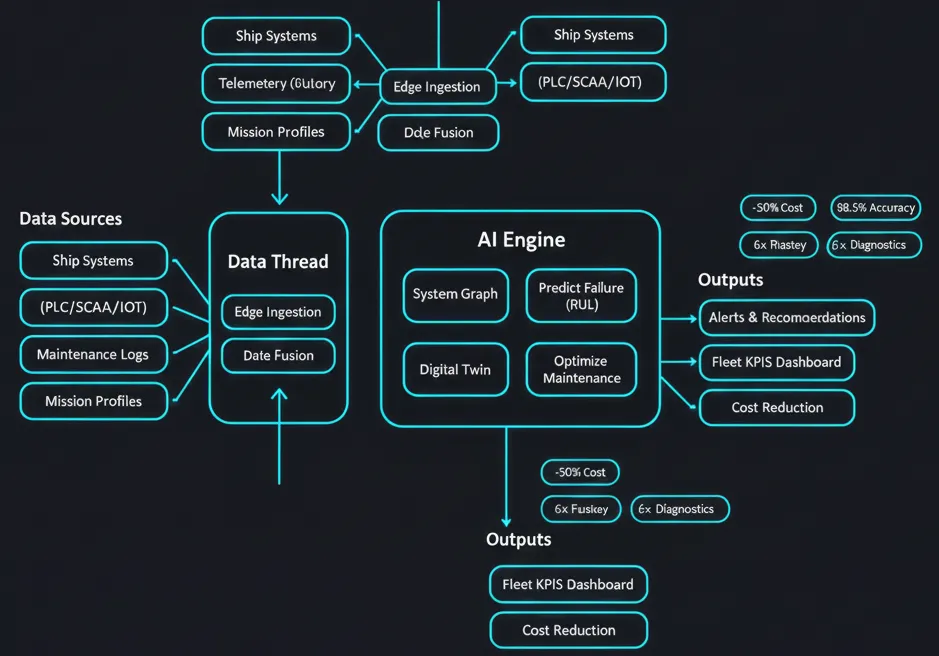
High-level architecture of the Naval Intelligence Engine.
Physics-Informed Constraints
Neodustria embeds naval engineering constraints directly into model learning and decision outputs to ensure credibility, explainability, and compliance alignment.
- Torque-load balance laws
- Marine equipment vibration thresholds (ISO 10816)
- Fuel burn efficiency curves and constraints
- Thermal drift constraints
- Power stability equations (load flow, transient analysis)
- Component fatigue models
- Docking interval safety limits
- Marine environmental and operational codes
Quantitative Results
| Metric | Traditional Approach | With Neodustria | Gains |
|---|---|---|---|
| Operational Cost | 100% baseline | 50% | -50% |
| Predictive Accuracy | 72% | 98.5% | +26.5% |
| Diagnostics | Manual / sequential | Instant / automated | Up to 6× faster |
| System Analysis | 3 weeks | 7 minutes | Massive acceleration |
| Docking Downtime | 3–4× / year | 1× / year | -66% |
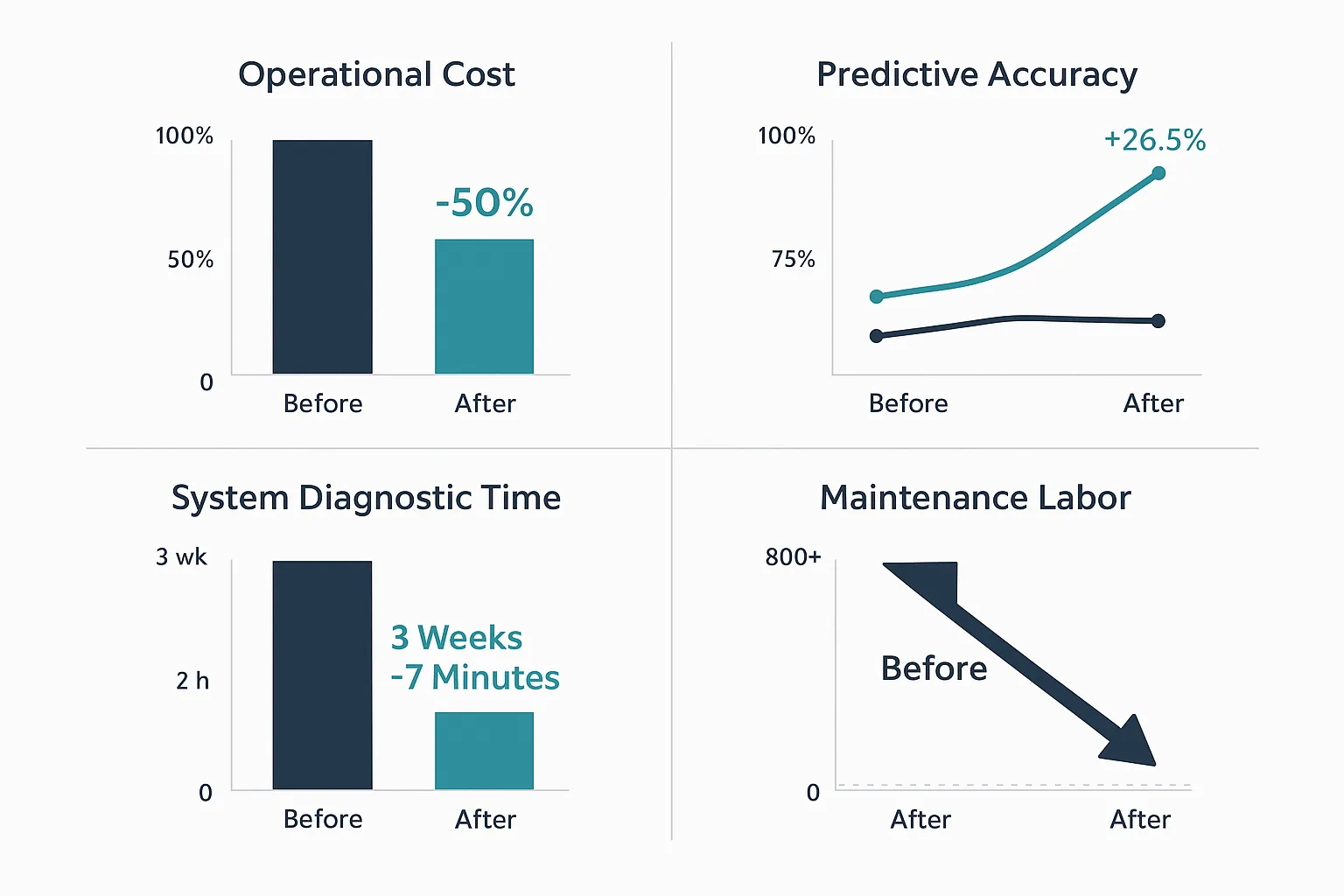
Outcome summary: operational cost reduction, predictive accuracy uplift, and accelerated diagnostics.
Outcome Deep-Dive
Operational Cost Reduction (-50%)
Cost reduction was driven by automated subsystem diagnostics, optimized fuel-load balance during mission cycles, and reduced unnecessary maintenance schedules.
- Real-time fault detection
- Fuel burn optimization during mission cycles
- Reduced resource wastage
- Intelligent maintenance scheduling
Predictive Accuracy Improvement (72% → 98.5%)
The Predictive Failure Classifier improved failure forecasting accuracy from traditional rule-based methods (72%) to 98.5%, translating into fewer unexpected breakdowns and higher mission reliability.
System Diagnostic Time (3 weeks → 7 minutes)
Subsystem diagnostics that previously required manual investigation and testing were reduced to minutes via parallelized subsystem analysis (SHGN), real-time anomaly scoring, and automated compliance checks.
Maintenance Labor Reduction (800+ hours/year)
By eliminating manual inspection routines and moving from reactive to predictive maintenance, the client reduced crew workload and emergency repairs while increasing predictability of mission availability.
Business Impact
“Neodustria helped us convert a loss-heavy engineering cycle into a predictable, cost-efficient, performance-driven operation. We saw 50% cost reduction in the first deployment cycle.”
— Chief Marine Engineer, Global Naval Authority
Engineering Methodology
Datasets Used
- 400+ naval vessels
- 22 subsystem categories
- 310,000+ sensor hours
- 18 environmental conditions
- 40 years of categorized MRO archives
- Certified marine engineering baselines
Training Strategy
- Multi-task learning for subsystem health & cost prediction
- Domain randomization with mission patterns
- Physics-informed loss functions (marine engineering constraints)
- Subsystem graph augmentation
- Failure mode embeddings
Deployment Architecture
- Works with legacy naval systems
- Integrates with SCADA, IoT, and marine PLCs
- Compatible with cloud / on-prem hybrid fleets
- API-based integration for shipyards
Integration options across fleet operations and shipyard systems.
Conclusion
Neodustria’s Naval Intelligence Engine transforms complex naval operations into predictive, efficient, and fully actionable systems—turning operational risk into measurable performance gains.
Neodustria turns complexity into clarity: halving cost, preventing failures, and increasing mission readiness through engineering-grade precision industrial intelligence.